
Export boost, cheaper cars & whisky: India-UK trade deal comes into effect from July 15 – How India & Indians will benefit
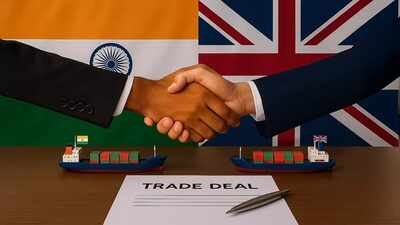
India-UK FTA: The India-UK Comprehensive Economic and Trade Agreement or CETA comes into effect from July 15, 2026. The landmark trade deal is set to deliver several benefits to Indian exporters and consumers in terms of greater access to UK markets and imported goods at cheaper costs respectively.With its implementation, the trade deal will become the sixth free trade agreement brought into force during the Narendra Modi government’s tenure. India has previously implemented similar agreements with Mauritius, the UAE, Australia, the European Free Trade Association (EFTA) and Oman.Considered one of India’s most significant trade agreements in recent years, CETA will provide duty-free market access for almost 99% of Indian exports.Trade between India and the UK increased by 8.62% to $25.12 billion in 2025-26, compared with $23.13 billion in 2024-25. During the same period, India’s exports declined 7.6% to $13.44 billion, while imports from the UK rose 36.11% to $11.68 billion.India received foreign direct investment (FDI) worth $1 billion during 2025-26, up from $795 million in 2024-25.
How trade deal benefits India & UK
Agneshwar Sen, Trade Policy Leader, EY India says that as the India–UK FTA comes into effect, businesses on both sides stand to benefit from improved market access, lower trade costs and greater certainty across goods and services trade.“The opportunities are particularly significant for sectors such as textiles and apparel, leather and footwear, gems and jewellery, engineering goods, auto components, chemicals, agriculture and marine products, as well as IT, financial and professional services,” he says.
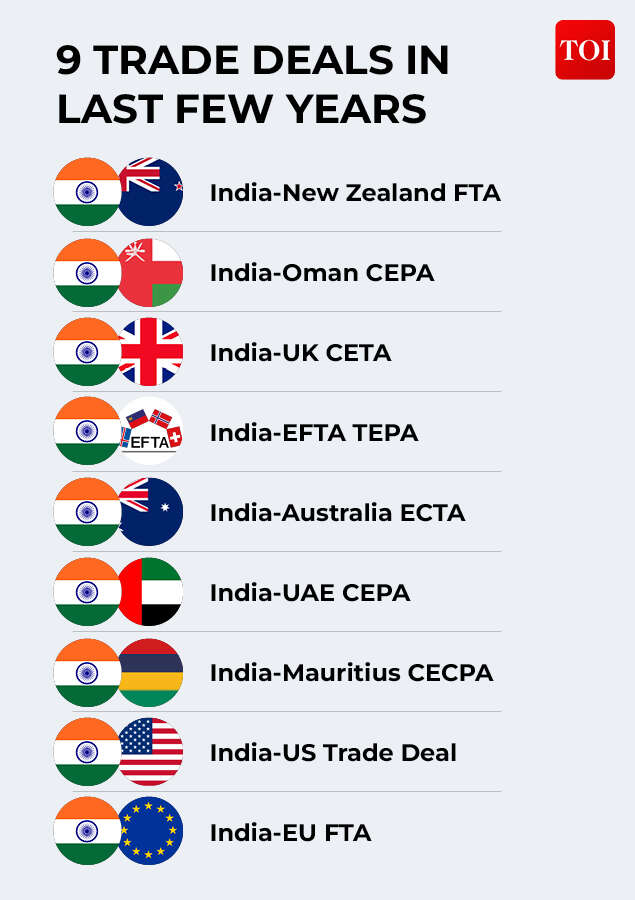
Nine Trade Deals in Last Few Years
Notably, the agreement marks one of India’s first major trade agreements with a developed economy to enter into force in recent years, helping Indian businesses become more familiar with advanced regulatory standards, compliance requirements and trade facilitation processes that characterise developed markets.“However, the realisation of these benefits will depend on effective implementation, adherence to rules of origin requirements and the ability of businesses to align their supply chains and compliance frameworks. The agreement is also significant in a broader context, reflecting India’s increasingly proactive trade strategy and its ambition to deepen participation in global value chains and strengthen economic partnerships with key markets,” he adds.
- Labour-intensive industries, including garments, textiles, footwear, carpets, processed food, cereals, vegetables, fruits, spices, fish, meat and processed food products, will receive duty-free access to the UK market. At present, these products attract import duties ranging from 4% to 16%.
- The agreement is also expected to benefit sectors such as automobiles, motorcycles and auto components, machinery, electronics, fabricated metal products, and products related to ceramics, glass, stone and cement.
- On the import side, lower tariffs on British products—including salmon, lamb, machinery, electronics, chocolates, soft drinks, cosmetics, cosmetic soaps, perfumes, shaving creams and nail polish—could result in lower prices for consumers in India.
- Under the agreement, India will gradually reduce the import tariff on silver, its largest import from the UK, to zero over a period of 10 years.
- India has excluded several products from tariff concessions under the agreement. These include fresh apples, walnuts, whey and modified whey, blue-veined cheese, specified categories of seeds, gold bars and smartphones.
- On the other hand, the UK’s exclusion list covers meat items, egg-based products, semi-milled and fully milled rice, as well as solid-form cane and beet sugar among others.
- According to GTRI, UK’s main gains are concentrated in sectors such as precious metals, aerospace, premium automobiles and alcoholic beverages.
- Among the biggest beneficiaries are high-purity silver bars. The agreement also provides significant benefits to Britain’s aerospace sector.
Sectoral impact:
Auto – cheaper Jaguars!For the first time under a free trade agreement, India has agreed to significantly lower import duties on fully built cars and trucks manufactured in the UK. The tariff on these vehicles will be reduced in phases from 110% to 10%.Concessional treatment for petrol and diesel vehicles will begin immediately. However, electric, hybrid and hydrogen-powered passenger vehicles from the UK will receive preferential market access only from the sixth year of the agreement, effectively providing Indian electric vehicle manufacturers with five years of protection.During the first 15 years of the agreement’s implementation, India will permit the import of 3.78 lakh fully built passenger vehicles powered by conventional engines from the UK, including mass-market models, at concessional customs duty.Tariffs on fully built trucks imported from the UK will also be reduced. Within the prescribed quota, the existing 44% duty will be brought down to 8.8% by the fifth year. The annual quota will increase from 2,500 trucks in the first year to 3,500 trucks from the fifth year onwards. Even trucks imported beyond the quota will benefit, with the applicable tariff declining gradually to 22% by the tenth year.The UK, in turn, has extended tariff concessions for passenger vehicles from India powered by electric, hybrid and hydrogen technologies. While the UK’s standard import duty on passenger cars is 10%, qualifying Indian vehicles exported within the annual quota will receive duty-free access under CETA, providing them with a 10-percentage-point tariff advantage.Alcohol – Scotch whisky gets cheaperThe agreement provides for tariff reductions on a broad range of premium alcoholic beverages, including cider, mead, sake, brandy, bourbon, rum, gin, vodka, liqueurs and tequila.For eligible products, the prevailing import duty of 150% will be reduced to 110% in the first year and further lowered to 75% by the tenth year. These concessions will apply only to imports above the prescribed minimum import price (MIP), generally set at $5 per litre, equivalent to $3.75 for a 750 ml bottle, or $6 per 750 ml bottle, depending on the product.For Scotch whisky, India will reduce the import duty from 150% to 75% at the outset, with the tariff declining further to 40% by the tenth year.Government procurementAs part of the agreement, India has opened its government procurement market to UK suppliers. For the first time, around 40,000 high-value procurement contracts floated by central ministries and departments across sectors such as transport, green energy and infrastructure will be accessible to eligible UK bidders.The agreement provides UK suppliers with treaty-backed access to covered central government procurement opportunities in India. Companies that satisfy a 20% UK-content requirement may also qualify as Class 2 Local Suppliers.Intellectual property rightsAccording to the Global Trade Research Initiative (GTRI), India did not agree to patent-term extensions or pharmaceutical data exclusivity. However, it accepted stronger commitments on intellectual property enforcement while recognising voluntary licensing as the preferred mechanism.The agreement does not, however, place any restriction on India’s ability to use compulsory licensing (CL). Compulsory licensing remains an important mechanism for ensuring access to life-saving technologies during emergencies.
Double Contribution Convention
Indian companies with operations in the UK will be exempt from making social security contributions for up to five years for employees deputed from India to support their UK businesses. The provision is expected to provide a significant advantage to major IT companies such as Tata Consultancy Services (TCS) and Infosys.Steel safeguardAccording to GTRI, India exported steel and steel products worth about $900 million to the UK in FY2026, accounting for nearly 7% of its total merchandise exports to the country, which stood at $13.4 billion. However, the think tank said these exports could face pressure as the UK introduces a stricter steel import regime from July 1, 2026.