
Loan repayment cap for MFIs to stay: RBI
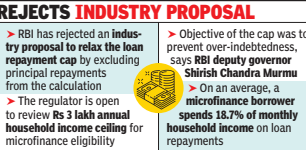
MUMBAI: RBI has made it clear that microfinance institutions cannot allow borrowers’ total monthly loan repayments to exceed 50% of their household income, rejecting an industry proposal to relax the cap by excluding principal repayments from the calculation.The regulator, however, is open to reviewing the Rs 3 lakh annual household income ceiling for microfinance eligibility, depending on industry developments and its assessment of the need for a revision. “Excluding some loans from the calculation would defeat this purpose, tinker with the sanctity of the limit and understate household leverage,” RBI deputy governor Shirish Chandra Murmu said.
Rejects industry proposal
Under RBI’s 2022 regulatory framework, households with an annual income of up to Rs 3 lakh are eligible for microfinance loans from regulated lenders. Their total monthly loan repayments across lenders cannot exceed 50% of household income.Known as the Fixed Obligation to Income Ratio (FOIR), the measure captures the proportion of a household’s monthly income committed to servicing loans. For instance, if a household earns Rs 20,000 a month, its combined monthly repayments across loans cannot exceed Rs 10,000. Both principal and interest payments are included.Microfinance lenders had sought a more accommodative interpretation that would exclude the principal component of certain loans and count only interest payments. This would have reduced the repayment burden recorded under FOIR and created room for lenders to extend additional credit without breaching the 50% ceiling.Murmu said the objective of the cap was to prevent over-indebtedness, while ensuring that a reasonable share of household income remained available for essential consumption and other living expenses. He said 50% was already a liberal threshold given the limited financial cushion of low-income households and their vulnerability to economic shocks.Citing a recent study, he said the average microfinance borrower spends 18.7% of monthly household income on loan repayments, while close to two-thirds goes towards consumption. NABARD’s rural economic conditions and sentiments surveys showed a similar pattern, with consumption and other expenses accounting for roughly three-fourths of monthly household income.“In such a scenario, an accommodative view on FOIR may be uncalled for,” Murmu said, adding that the regulatory FOIR should be treated as a prudential maximum and not a target that every household has to meet.On Rs 3 lakh annual household income threshold, Murmu said a review would be undertaken depending on RBI’s assessment of the need for a revision and developments in the industry.