


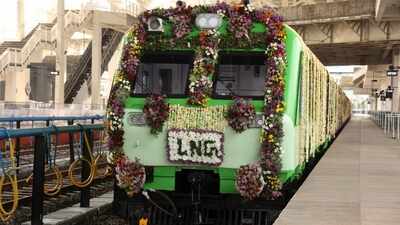
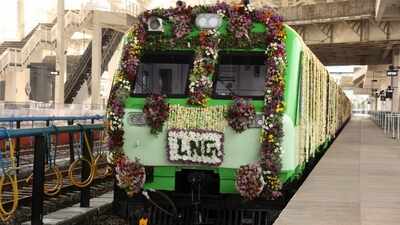
Within months of launching its first hydrogen train, Indian Railways has now rolled out its first LNG train. Home Minister Amit Shah on Sunday flagged off India’s first LNG train from Sabarmati station in Gujarat.The move is part of the national transporter’s broader push to reduce carbon emissions and move towards more sustainable modes of transport.At the event, Shah also flagged off a WAG-12 electric locomotive from Sabarmati station. Several railway projects of over Rs 1500 crore in total were also dedicated to the nation, inaugurated or taken up for foundation stone laying. These included railway line doubling projects, the Kavach train protection system, automatic signalling works and a maintenance shed for WAG-12 electric locomotives.
India’s first LNG train
Shah said that the LNG-powered train will make a significant contribution to environmental conservation in the years to come.The LNG-powered train operates on a dual-fuel diesel-plus-LNG system developed for its Driving Power Cars (DPCs).At the Sabarmati Integrated Coaching Depot, two DPCs, each with a power capacity of 1,400 HP, have been modified to operate using the dual-fuel technology. The system allows the locomotives to use LNG along with diesel.The two converted DPCs have undergone more than 2,000 km of field trials to evaluate the technology’s performance and reliability under operating conditions, reports suggest.Also Read | Why India’s first hydrogen train is special – explainedThe dual-fuel arrangement allows LNG to substitute for around 40 per cent of diesel consumption. Trial data released by the Railways indicates that the technology could lower fuel costs as well as emissions, including carbon dioxide, nitrogen oxides and particulate matter.The technology also gives the engine the flexibility to operate on either LNG or diesel based on fuel availability. This allows the train to continue operating without being dependent on a single fuel source, reports say.While using LNG to replace part of the diesel requirement, the system has been designed to preserve the conventional diesel engine’s power and operational capabilities.Each converted DPC is equipped with an LNG tank holding around 2,200 litres. The tank can accommodate approximately 850-900 kg of usable LNG.A full tank of LNG is expected to support around 1,600 km of operations, thereby reducing the frequency with which the train needs to refuel.
Indian Railways targets net zero
Amit Shah also highlighted several infrastructure and operational changes. He said 97% of bio-toilets had been installed in trains under the Modi government, while 87% of LBH coaches produced during the Prime Minister’s tenure were manufactured in India.According to Shah, railway electrification increased by 70%, the budget allocated for railway safety rose by 67% and locomotive production capacity expanded by 66% during Modi’s tenure.“Modi solidified the concept of Make in India, the concept of self-reliant India, and this is the result of it. In 2015-16, Railways used 293 crore litres of diesel. By 2024-25 it will be 108 crore litres, and by 2030 it will be reduced to zero. We will save currency. This is a great achievement which does not come to people’s attention,” Shah said.He further pointed to the pace of railway electrification, saying that the annual addition of electrified railway tracks had risen from 75 km in 2010-11 to 7,188 km in 2023-24. Shah said the task, which he described as difficult, had been completed smoothly.“Railways has completed 99.6 percent electrification. We will complete the remaining 0.3 percent. Electrification is 92 percent in China, 68 percent in Spain, 60 in France, and 49 percent in a small country like Britain. We will move ahead by ensuring it is 100 percent in India,” he said.