




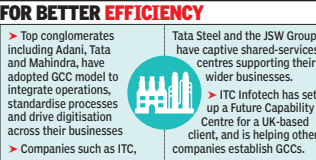
NEW DELHI: Global capability centres (GCCs), initially set up by MNCs in India to tap skilled talent, lower operating costs and manage global operations more efficiently, are finding growing acceptance among Indian businesses too. From conglomerates to companies with overseas operations, domestic firms are creating dedicated centres to bring technology, finance and human resources under one roof, reflecting a shift towards centralised operations.Top conglomerates including Adani, Tata and Mahindra, have adopted the model to integrate operations, standardise processes and drive digitisation across their businesses.

For better efficiency
While no specific number capturing the rising trend is available yet, multiple companies and industry experts confirmed to TOI that adoption is gathering pace across sectors.India has 2,117 GCCs employing around 2.36 million professionals, according to the Nasscom-Zinnov FY26 report. Most are MNC-led, with mandates extending beyond cost arbitrage to technology, AI, engineering and product development.Says Bhanu Prakash Kalmath SJ, healthcare industry leader, Grant Thornton Bharat: As businesses become more global, digitally intensive and organisationally complex, dedicated capability centres can give strategic leverage and consolidate functions otherwise dispersed across business units or external providers, while building common technology platforms, retaining institutional knowledge, strengthening innovation and creating deeper pools of specialist talent, while delivering efficiency”.Indian conglomerates, which have global operations have also been adopting the model to drive up efficiency and competitive advantage, adds Shalini Pillay, India leader – GCC, KPMG India. The trend is also spread to mid-sized companies with service providers helping them to establish and scale such centres.Some groups are taking this a step further by commercialising capabilities developed for captive internal use. For instance, Strides Pharma’s Arcolab, which began as a captive shared-services organisation, evolved into Pivot Path recently.Companies such as ITC, Tata Steel and the JSW Group have captive shared-services centres supporting their wider businesses. Separately, ITC Infotech has set up a Future Capability Centre for a UK-based client, and is helping other companies establish GCCs.Further, the pharmaceutical sector has adopted the trend, particularly among domestic companies with sizeable international operations. Domestic companies are increasingly exploring the GCC model to achieve scale and tap into innovation, taking a cue from MNCs that have expanded their GCC operations, said Sujay Shetty, global health industries advisory leader, PwC India.