


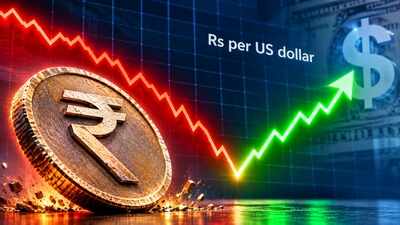
In May this year, the rupee hit the 100-mark in the forward market. Economists started talking about the possibility of the Indian currency breaching the psychological 100-mark given the sharp depreciation that rupee had seen in 2025 and more so in 2026 amid the US-Iran war.Six months later, the situation has changed drastically.Rupee has given up its losses in the ongoing financial year 2026-27, and has appreciated sharply from its all time low level of almost 97 versus the US dollar. At Friday’s closing of 92.9, it is now down over 3% since the start of the year.The appreciation has been so rapid that the rupee has become Asia’s best performing currency in November.Chief Economic Advisor V Anantha Nageswaran has even said that the challenge for India next year could be managing the rupee’s strength rather than its weakness!What has led to the rapid appreciation in rupee, is the trend sustainable, and why would a stronger rupee pose problems? We take a look:
Rupee’s rapid fall and rapid rise
Let’s first understand what influences the movement of rupee versus the US dollar: it depends on demand and supply for the US dollar, foreign investor flows, crude oil prices, India’s trade deficit and the dollar’s global strength.Higher oil prices and foreign fund outflows tend to weaken the rupee, while strong capital inflows, export earnings and RBI intervention can support it.In 2025, amid the Trump administration’s tariff policy uncertainty and growing global focus on artificial intelligence related trade, Indian markets were mostly out of favour for foreign investors. This led to record outflows, which in turn weakened the rupee.2026 saw the US-Iran war sending global crude oil prices soaring, which in turn exacerbated the pressure on rupee.The Reserve Bank of India (RBI) intervened to stem the rapid fall of rupee, introducing a slew of measures, particularly the FCNR(B) deposits window which led to foreign exchange reserves hitting an all-time high of over $780 billion. That gave the central bank a big buffer to control the rapid fall of the rupee.But what has suddenly turned fortunes is a wave of favourable global factors. Crude oil prices have dropped drastically, which reduces the biggest headwind for India’s import bill. Globally, AI stocks have hit a rough patch, leading to record foreign investor inflows into the Indian market, also spurred by some relief on the long-term capital gains tax front in the upcoming Budget.Sensex has risen almost 12% in November so far, and has already erased losses since the start of the war at the end of February.Foreign investor inflows have hit a record high of Rs 1,43,284 crore till November 26.But, why does CEA think the rupee’s strength would be a problem?
Appreciating rupee: The problem and the benefits
Economists warn that a rapid or sustained appreciation can create challenges for export competitiveness and reduce rupee realisations for exporters, particularly in sectors with substantial foreign-currency revenues. India’s exports are projected to hit $1 trillion in this financial year.“The distinction is between an orderly appreciation reflecting stronger fundamentals and a sharp appreciation driven by concentrated capital inflows. The latter can create adjustment challenges for businesses and the external sector,” Sujan Hajra, Chief Economist and Executive Director at Anand Rathi Group tells TOI.Now, the expectation is that the recent appreciation of the rupee could continue into FY28 as well, particularly if lower global crude oil prices and stronger capital inflows improve India’s external position.Fundamentally, an appreciating rupee creates a problem for both merchandise and services exports, because it affects their external price competitiveness.Ranen Banerjee, Partner and Leader, Economic Advisory, PwC India says, “Given the trade disruptions, it will be an additional headwind making Indian exports relatively less competitive.”Lower value of imports will also pose a problem.“A lower value of imports would mean lower GST collections on the same. The institutional investors would however be happy and find the Indian market further attractive in terms of dollar returns and it is likely to support investment flows to the Indian market,” Banerjee tells TOI.Vivek Kumar, Economist at QuantEco explains that export-oriented sectors such as IT services, textiles, apparel, gems and jewellery, and select pharmaceutical companies could face pressure on revenue realisation and profit margins.“Labour-intensive merchandise exporters could be particularly vulnerable given the prevailing uncertainties in global trade. However, much would depend on the extent of appreciation vis-à-vis India’s trade competitors, the import intensity of exports, and the degree of currency hedging,” he tells TOI.There are many benefits too. A strengthening rupee means that the imported cost of goods goes down, which in turn lowers inflation.An appreciating rupee generally improves India’s purchasing power internationally, reduces the cost of imported commodities and intermediate goods, and helps contain imported inflation.The fall in inflation is particularly important for an economy like India, where crude oil imports have a significant bearing on the trade balance and domestic inflation.DK Srivastava, Chief Policy Advisor, EY India says, “The clearest beneficiaries would be sectors that import a significant proportion of their inputs. Oil-marketing companies, the aviation sector and producers of paints, chemicals and logistics are likely to benefit from cheaper imported crude and fuel.”“Further, gains may also accrue to sectors like electronics, telecom, capital-goods and renewable-energy companies which are dependent on imported machinery, components and equipment,” he tells TOI.Not just that, the inflation reducing effect can also be significant since India has suffered from cost push imported inflation in FY27 mainly because of relatively high crude prices and prices of natural gas and fertilizers.“Certain export-oriented sectors, including IT and business-process services, pharmaceuticals, textiles and apparel, gems and jewellery, engineering goods and auto components, may see some impact,” he adds.
Where is rupee headed next year and will RBI intervene if it appreciates too much?
There is little consensus among economists on where the rupee is headed next year, with a broad range being predicted.They believe that the trajectory will depend on crude oil prices, the strength of the US dollar, sustainability of foreign capital inflows and India’s external balance. A moderation in crude prices and sustained capital inflows could keep the rupee relatively stronger, while higher oil prices or a reversal in flows could bring depreciation pressure.Sujan Hajra says that for the next 12 months, USD/INR would be in the 94–96 range.“This is an indicative medium-term assessment, not a hard target or a prediction of a one-way movement,” he says.DK Srivastava of EY India believes that the RBI should continue to focus on containing excessive exchange-rate volatility while allowing market forces to determine the rupee’s underlying trend.“If the rupee continues to appreciate on a trend basis, that may be allowed to continue. Intervention should be calibrated to address sharp or disorderly movements rather than to defend any predetermined level of the exchange rate,” he says.If present trends continue and global crude prices remain benign, he assessed that rupee will settle down in the broad range of 87-91 versus the US dollar in FY28.Sujan Hajra explains the two-sided approach of the central bank: RBI can purchase dollars during periods of excessive appreciation pressure and sell dollars during periods of excessive depreciation pressure.“Therefore, the objective should not be to prevent rupee appreciation or depreciation, but to ensure that currency movements remain orderly and broadly reflect underlying economic fundamentals,” he says.Vivek Kumar of QuantEco is of the view that the central bank should not resist an appreciation that is justified by an improvement in India’s underlying economic fundamentals.“The objective should be to manage the pace of currency movement rather than defend a particular exchange rate level. The RBI should also assess currency strength through the prism of the real effective exchange rate rather than merely the bilateral USDINR exchange rate. Some recovery in the rupee could represent a correction of its earlier undervaluation rather than an erosion of export competitiveness,” he says.In the current context, there is an additional strategic consideration. Given the unprecedented expansion in the RBI’s outstanding short dollar forward book, a phase of rupee appreciation would provide a valuable opportunity to rebuild its net foreign exchange reserve cushion.
The Bottom Line
The exchange rate has several bearings on various parts of the economy, as long as the rupee glides towards the real effective exchange rate and does not get overvalued, the RBI as per its stated policy should limit itself to managing the volatility and not the level of the rupee.Just like a rapid depreciation in rupee has brought its set of external headwinds, a sharp appreciation too would not bode well.In the current circumstances, stronger capital inflows and improved external conditions provide room for the rupee to adjust to market forces. At the same time, intervention may be warranted if appreciation becomes excessive or disorderly, particularly given its implications for export competitiveness and market stability.But ultimately, for a net commodity-importing economy like India, a moderate appreciation of the currency would be welcome from an inflation management perspective.This is because it would lower the cost of imported energy, raw materials, capital goods and technology, thereby improve domestic purchasing power and potentially support consumption and investment.“As per the RBI estimates, a 5% appreciation of the rupee could lower inflation by around 40 bps, assuming full pass through,” Vivek Kumar tells TOI.“The distinction between a gradual appreciation backed by improving economic fundamentals and a sharp appreciation driven by transient capital flows becomes critical. The former could enhance economic welfare, while the latter could undermine competitiveness and employment generation,” he concludes.