


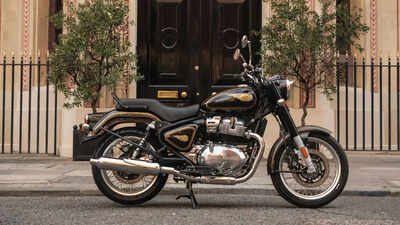
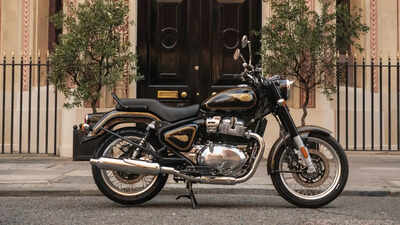
Royal Enfield has launched the much-awaited Bullet 650 in India at a starting price of Rs 3.65 lakh, ex-showroom. This will be the most powerful Bullet ever sold in the country and brings the iconic Bullet design together with Royal Enfield’s proven 650cc parallel-twin platform. Here’s a quick look at some key details.
Royal Enfield Bullet 650: All you need to know
The Bullet 650 was first showcased globally at EICMA 2025 in Milan before making its India debut at Royal Enfield Motoverse 2025. With this launch, the Chennai-based manufacturer has further expanded its growing 650cc lineup, which already includes models like the Interceptor 650, Continental GT 650, Super Meteor 650, Shotgun 650 and Bear 650.Visually, the new Bullet 650 gets the signature teardrop-shaped fuel tank with hand-painted gold pinstripes and the winged emblem on the fuel tank. Other retro-inspired touches include the round LED headlamp with tiger-eye pilot lamps, chrome-finished pea-shooter exhausts, chrome mirrors and handlebars, along with a large rear fender that closely resembles the smaller Bullet 350. The Bullet 650 gets a single-piece seat inspired by the original Bullet bench design. The motorcycle will be available in two colour options: Cannon Black and Battleship Blue. Powering the Bullet 650 is the familiar 647.95cc air and oil-cooled parallel-twin engine seen across Royal Enfield’s 650 range. The motor produces 46.4 bhp and 52.3 Nm of torque and comes paired with a 6-speed gearbox along with a slip-and-assist clutch. The Bullet 650 also boasts of retro-style rotary controls and adjustable levers. The updated instrument console combines an analogue speedometer with a digital information display showing details like fuel level, gear position indicator and service reminders. The motorcycle also comes with the Tripper navigation pod.As for suspension, it gets 41 mm telescopic front forks with 120 mm travel and twin rear shock absorbers offering 112 mm travel. The Bullet 650 rides on spoke wheels, with a 19-inch front and 18-inch rear setup. Braking duties are handled by a 320 mm front disc and a 300 mm rear disc, supported by dual-channel ABS.