


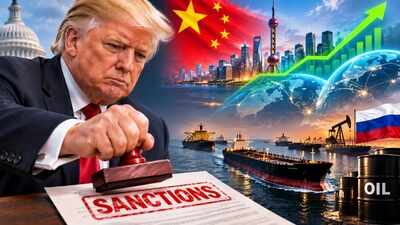
For a long time, secondary sanctions have served to be an effective tool for the US. The Donald Trump administration has been aggressively using them in a bid to exercise geoeconomic influence over individuals, businesses and banks linked to countries that it considers as adversaries.In fact, for many years, these measures have proved to be highly effective tools of economic pressure. From the 1980s to the 2010s, the US increasingly used secondary sanctions to transform the dollar-based financial system into a powerful instrument for exerting geopolitical pressure and isolating foreign governments and companies.But that seems to be changing now. Tariffs, secondary sanctions and more – the Donald Trump administration has all tried several tricks up its sleeve to browbeat the global economy. But, the world has survived.A recent report by Henrich Foundation notes: “Overwhelming US sanctions power was for many years a strategic substitute for US military power projection, allowing the economic containment of rival states and thereby freeing up military resources for prime theaters such as the Middle East and East Asia.“In both these regions, however, US military power and sanctions power now appear less capable of deterrence than before,” it says.What has changed? Why is the world less affected by US sanctions and what does this mean for India?
How the US built its sanctions power
For decades, the United States relied on its overwhelming ability to impose sanctions as an alternative to projecting military power. Economic restrictions helped Washington contain rival states while allowing it to reserve military resources for strategically important regions, particularly the Middle East and East Asia.Whether it was the 2000s or 2010s, the US used secondary sanctions to compel European banks to comply with restrictions that were targeted at Iran, Sudan and Cuba.It all started with the growing strength of the dollar as part of the integrated global trading system from the 1980s onwards. This raised the economic cost for countries of being cut off from the US dollar system.According to the Henrich Foundation report, “The traded goods share of global GDP rose continuously from 36% of global GDP in 1979 to 55% of global GDP in 2015.”By the late 1990s and the 2000s, the dollar had firmly established itself not just as the world’s leading reserve currency, but also an important invoicing currency, borrowing currency, source of liquidity and vehicle currency for foreign investment.The United States also benefited from a substantial imbalance in economic power. Its position gave it a significant advantage over countries targeted by sanctions, which had relatively few options to retaliate against Washington’s economic measures.A further factor underpinning US sanctions’ power was the period of relative macroeconomic stability that lasted from the mid-1980s until the mid-2010s.According to Henrich, from 2010 onward, a fourth pillar further enhanced the US ability to target the main commodity export of its rivals: oil production.“Thanks to easy financing conditions, the US experienced a domestic shale oil boom and became a net exporter of fossil fuels,” its report says.
Diminshing impact of US sanctions power
Fundamentally, as the risk of sanctions has become more persistent, countries have grown increasingly interested in protecting themselves against their exposure to the US dollar.The Henrich report notes since 2017, and particularly after the “Liberation Day” tariffs that were introduced in spring 2025, US tariff measures have prompted changes in the configuration of global supply chains.“The growing use of export controls on all kinds of strategic items – semiconductors and chipmaking equipment, AI technology, rare earths, and so on – is driving companies and governments to invest in domestic production capacity and in stronger alliance networks that can secure these technologies,” the report says.“On the whole, the world economy has weathered the impact of trade conflict and economic warfare,” it adds.In fact, the report cautions that recent economic research indicates that these developments may weaken US power more severely and more quickly than measures of its overall control over global networks might imply.

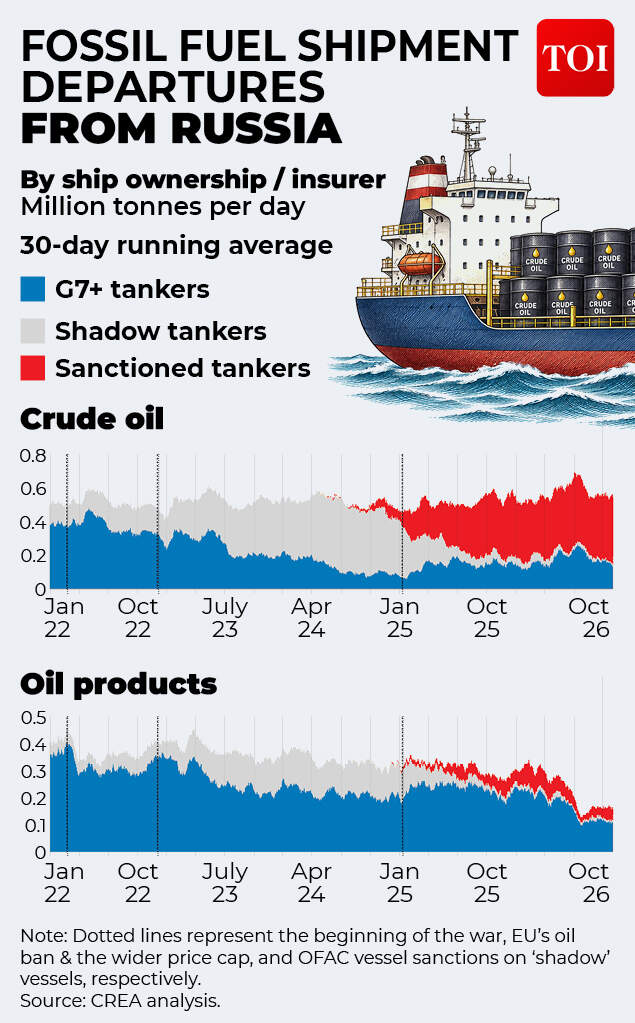
Fossil Fuel Shipment Departures From Russia
One of the biggest examples of the diminishing power of America’s secondary sanctions is the strong shadow tanker fleet that continues to globally transport Russian energy supplies.US sanctions against Iran and Venezuela during the 2010s, followed by the coordinated G7 measures against Russia in the early 2020s, progressively excluded several major oil-producing countries from the unrestricted international market centred on the Brent crude benchmark.However, these restrictions did not eliminate the trade in oil. Instead, they redirected it towards alternative channels that are harder to monitor. The global oil market has, in effect, split into two segments: a largely unrestricted market accounting for most oil traded internationally, and a smaller but still substantial “shadow” market created by sanctions.“To supply the growing shadow market in oil, an entire ecosystem of tankers, shipping companies, and insurers formed. Many of this network’s participants function to facilitate the joint trade of Venezuela, Iran, and Russia, while supplying oil importers such as China, India, Türkiye, Vietnam, Indonesia, and others,” the report says.“Despite voluminous and regular new sanctions designations on these ships, companies, and facilitators, secondary sanctions have not proven capable of meaningfully reducing or permanently denting this gray oil market,” the report adds.

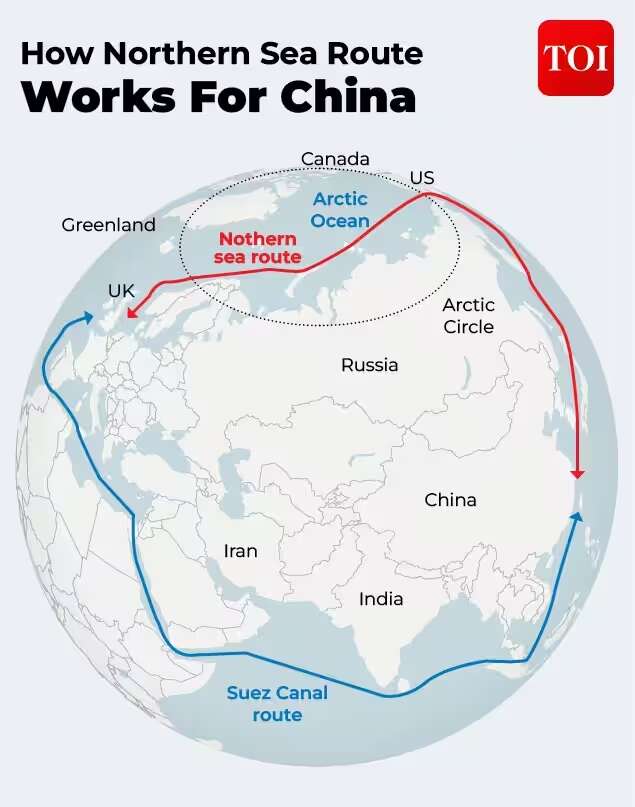
How Northern Sea Route Works For China
Not only that, Russia is actively exploring the Northern Sea Route for its exports.And then come China and Iran.China’s restrictions on rare earth exports, alongside Iran’s capacity to disrupt shipping in the Gulf and interfere with oil and gas production in the Persian Gulf and the Strait of Hormuz, have given these countries economic tools with which to push back directly against the US.“This development was apparent in October 2025, when a Chinese embargo on its rare earth exports forced Donald Trump to accept a tariff truce in the Sino-US trade war. Faced with growing shortages in US manufacturing and the defense industry, Trump agreed at an important meeting with Chinese President Xi Jinping at Busan in South Korea not to impose new export controls and to revert several recent controls on chip exports to China,’ the report explains.Caught off guard by US sanctions targeting its telecommunications sector and chipmakers in 2018–2019, Beijing has spent considerable effort developing a strategy to retaliate with economic pressure during Donald Trump’s second term. Since then, China has further expanded its permanent export-control machinery, ensuring that it can keep this option available for use whenever necessary.

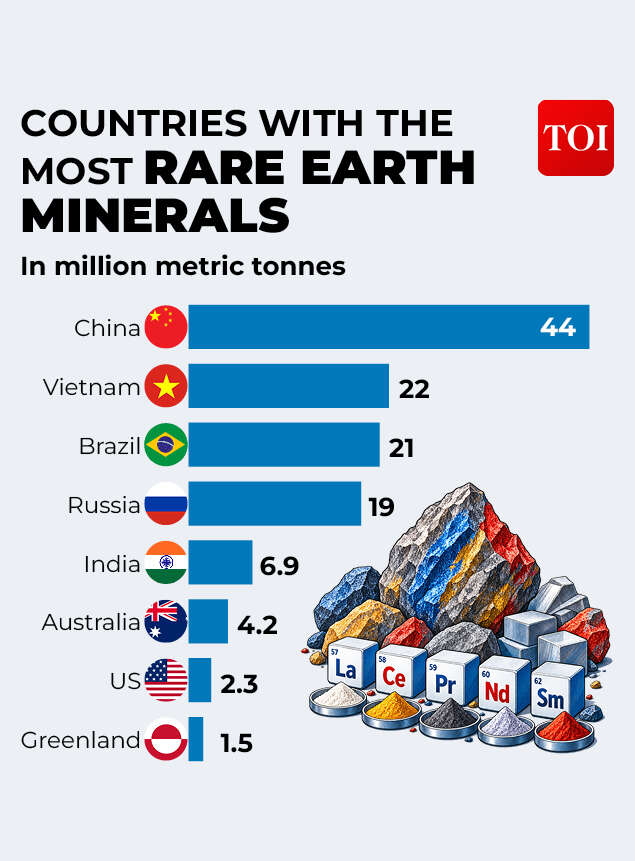
Countries with Most Rare Earths
“Any significant new US export controls and tariffs risk reactivating a painful Chinese response. But because this stability rests on a commitment to US abstinence from serious secondary sanctions against Chinese entities, Washington’s freedom of maneuver in this space is reduced in the long run,” the report says.Iran, too, has demonstrated its capacity to affect the US economy in 2026. The impact is less immediate and operates through indirect channels, but restrictions on traffic through the Strait of Hormuz have triggered a global fuel crisis with consequences for the American economy.Despite being a major exporter of fossil fuels, the US remains vulnerable to oil price shocks in particular product markets.Iran’s strategic position in the Strait of Hormuz, combined with Russia’s natural gas exports, gives the two countries control over approximately 42% of the global natural gas market, covering both liquefied natural gas and supplies transported through pipelines.
What this means for US
China, Iran and Russia have built up countervailing economic leverage across a range of critical resources, from rare earth metals to natural gas and petroleum products. Although these capabilities do not eliminate the considerable geoeconomic power that the US Treasury retains through secondary sanctions, they have made it harder for Washington to deploy economic coercion without facing resistance.

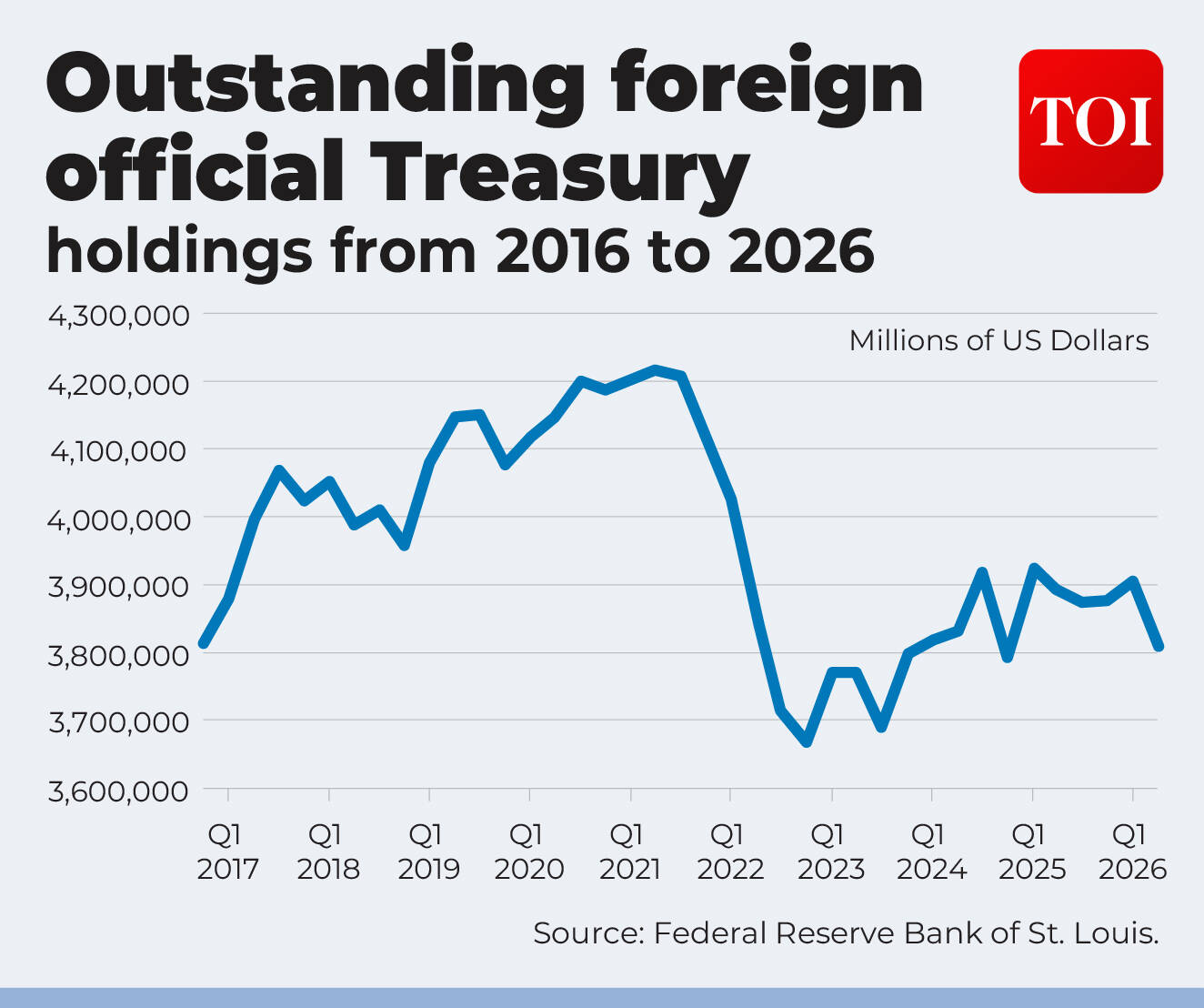
Outstanding foreign official Treasury Holdings
Yet another important point to note is that the effects of US sanctions are increasingly being felt in the Treasury market as foreign governments are reducing their exposure to US debt.The report points out that foreign official holdings fell 8.4% from $4.24 trillion in January 2021 to $3.87 trillion in December 2025, while China has more than halved its holdings over the past decade. This has given Beijing greater scope to use Treasury sales to pressure Washington.The trend accelerated after the US attack on Iran, with overseas public-sector holdings dropping 6.3% between February and August 2026, including a 31% fall in short-term Treasury bills to $312 billion.

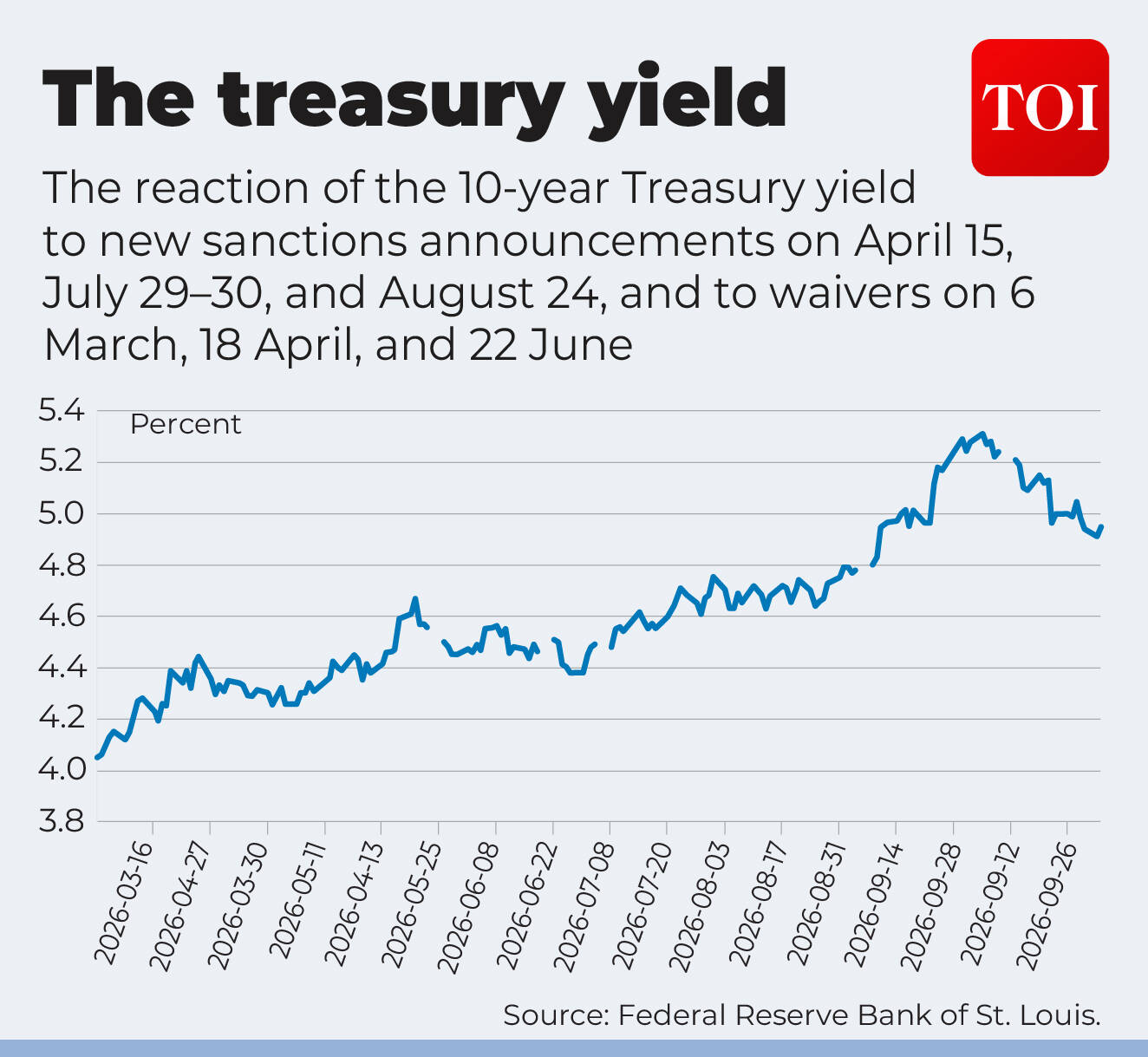
Reaction of 10-year Treasury yield to sanctions
What it means for India
For India, the news is mixed. Sanctions are seen as an economic leverage, but India has till now not finalised a trade deal with the US, insisting on a competitive advantage. It has also not stopped buying Russian crude. Resilience in exports through diversified markets and trade agreements has also helped in India.According to Vivek Iyer, Partner and Financial Services Risk Advisory Leader, Grant Thornton Bharat, India is moderately exposed to sanctions pressure, and in a few concentrated areas.“The thesis that alternative networks blunt sanctions mostly helps countries that are themselves sanctioned, like Russia and Iran. India is a third country. Its banks, exporters and refiners rely heavily on dollar clearing and US markets, so a secondary-sanctions threat still works on India even if it has weakened against Russia,” he tells TOI.Energy remains the biggest exposure. The new Sanctioning Russia and Iran Act allows the US to impose tariffs of up to 100 per cent on goods from the five biggest buyers of Russian oil and gas. India, which takes more Russian crude than any country except China, is one of them.On October 16, Trump waived sections 112 and 113 and most of the Act’s sanctions provisions, but that waiver is discretionary and can be reversed. Russia’s share of India’s crude imports was roughly 56% at its height and fell to about 35% in September.

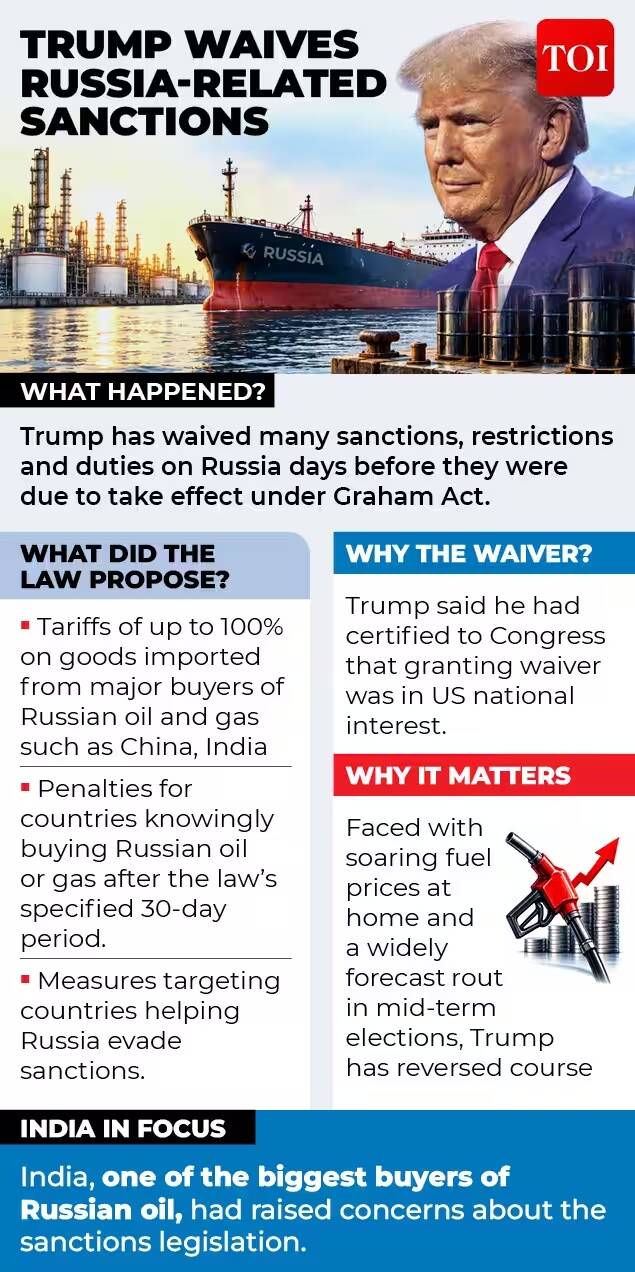
Trump waives Russia-related sanctions for India
And there is a past precedent to US pressure when Trump imposed a 25% penal tariff on India for its Russian oil purchases. India did not stop buying Russian crude oil due to tariffs, but subsequent sanctions on Russian oil majors did force it to recalibrate oil procurement strategy.Yet, the US needs India both strategically and in oil markets.Ajay Srivastava, founder, Global Trade Research Initiative (GTRI) believes that India remains vulnerable at both the company and country levels.“The risk has already shaped India’s energy choices. India stopped buying Iranian crude and previously cut back on Venezuelan oil to avoid US sanctions. The Russian oil tariff showed how a dispute over energy imports can reach Indian exporters with no connection to the oil trade,” he tells TOI.Yet, to a point tougher US sanctions may benefit India.“For the US, the costs show up as higher oil prices (the Rosneft/Lukoil sanctions precipitated an 8% increase in global Brent crude oil prices), tariffs paid by US consumers, and faster growth of alternative payment systems. For India, the possible gains include discounted crude, more trade settled in rupees, GIFT City attracting flows that are being diverted, and better market access if it lines up with the US,” Vivek Iyer tells TOI.