




NEW DELHI: There is a proverb. In English, it goes like, “Fortune favours the brave”. Let’s start with the “fortune” part. For 24-year-old Vaishali Rameshbabu, winning her game on Wednesday was not enough to make her a champion. Sharing the same 7.5/14 points as her was Bibisara Assaubayeva, who was up against Vaishali’s compatriot Divya Deshmukh at the Cap St Georges Hotel & Resort in Cyprus. And Divya didn’t disappoint, holding the co-leader to a stalemate.The “brave” part is where things get interesting. Playing white pieces while chasing a result, players often get greedy and make more adventurous, attacking moves on the board, weakening their defence in the process. Vaishali had white pieces. She was up against Russia’s Kateryna Lagno, a mother of four and quite brilliant at keeping a poker face on the table. Vaishali had to be brave to overcome the challenge posed by the veteran, and she did so with a clinical precision that belied the stakes.
With this victory, Vaishali became the first Indian woman to win the Candidates Tournament. While the legendary Koneru Humpy reached the World Championship final previously, she did so primarily through a knockout system during the hiatus of the Women’s Candidates format.For a player who started the tournament tentatively with a string of four draws and then a defeat in the fifth round, her late-surge comeback was nothing short of a hero’s act.She now stands as the second Indian ever to become a World Championship challenger and is set to face China’s Ju Wenjun later this year. But did she beat the 36-year-old?Caging the “Dragon” in Vaishali’s way“Vaishali’s last match against Lagno was a very well-played, smooth game in which she was throughout in a powerful position,” Thipsay told TimesofIndia.com after the game. “For the lowest-rated player in the tournament to come first is always a challenging thing. Sometimes players are not able to take courageous decisions, but this didn’t happen with Vaishali.”The battle lines were drawn early when Lagno opted for the sharp Dragon Variation of the Sicilian Defense. Vaishali countered with her preferred Yugoslav Attack, a system widely considered the most potent antidote to the Dragon. “She started with the ninth move long castle, popularised by Magnus Carlsen recently, followed by the standard 11. Bc4,” Thipsay explained. “Lagno chose a very sharp line, and I must appreciate that she did not play for a draw. She played an ambitious line with 11… Be6 after a 32-minute think, but it didn’t turn out well.”By move 16, Vaishali had secured a formidable position. Although Lagno introduced a novelty with 16… Bxb3, Thipsay pointed out it was a strategic blunder. “It’s a typical mistake which Bobby Fischer once said leads to a forced loss for Black. Vaishali made her only inaccuracy here by capturing 17. axb3 instead of cxb3, which momentarily reduced a commanding lead to a slight advantage.”However, the Russian veteran failed to seize the lifeline. On move 18, Lagno played e5 to avoid a bishop exchange, a move Thipsay termed the “decisive mistake”.“Had she exchanged bishops, there might have been drawing chances in a rook ending, a pawn down,” he told this website. “Instead, Lagno chose to retain the bishops. While Lagno’s bishop on g7 did nothing throughout the game, Vaishali’s bishop on c3 was active, and the game was won in a powerful manner.”

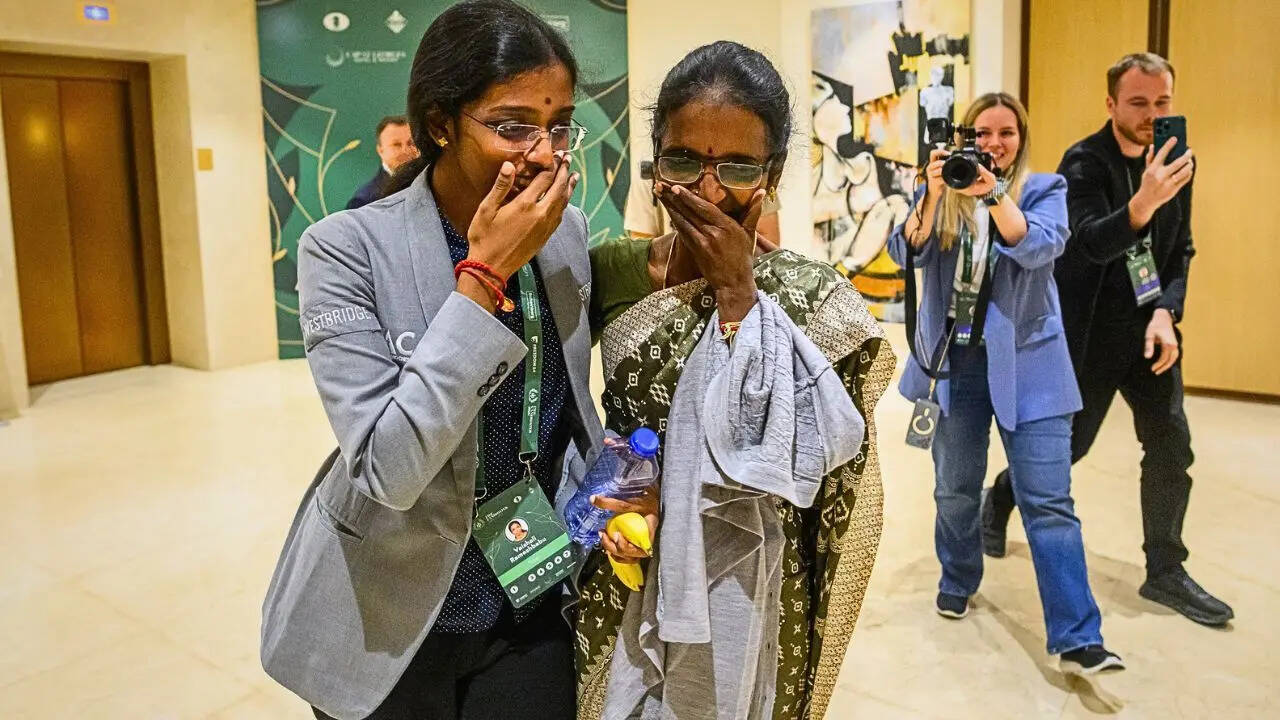
When Lagno finally resigned on the 48th move, the material imbalance between the players was jaw-dropping. Vaishali held a queen and two rooks against Lagno’s lone queen and bishop.Since 2016, the Women’s World Championship has been an all-Chinese affair. Vaishali’s qualification ensures that for the first time in a decade, a non-Chinese player will vie for the crown.The parallels to the 2024 cycle, however, are hard to ignore. “Let’s see if Vaishali is able to repeat what Gukesh did,” Thipsay remarked with a smile. “Gukesh, as a challenger, defeated the Chinese world champion Ding Liren in December 2024. In 2026, we may experience the same with Vaishali defeating Ju Wenjun.”