


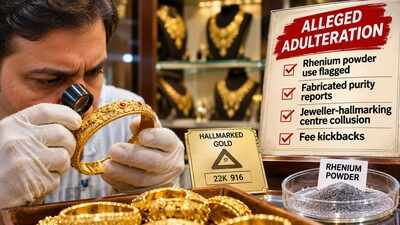
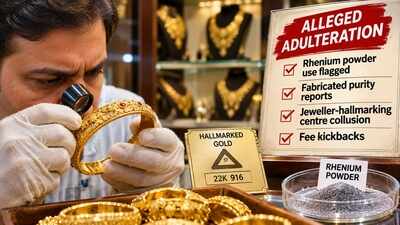
Gold prices are crashing and if you think this is a good time to buy jewellery, be alert about hallmarking in gold. Concerns have emerged over the credibility of India’s BIS certification system following allegations of widespread irregularities in gold hallmarking and refining.The India Bullion and Jewellers Association (IBJA) has raised suspicions of collusion between jewellers and hallmarking centres, fabricated purity reports, kickbacks linked to fees and sophisticated methods of adulterating gold using rhenium powder, according to an ET report.
Gold hallmarking concerns
In a representation submitted to the Bureau of Indian Standards (BIS), the association highlighted discrepancies in Hallmark Unique Identification (HUID) data displayed on the BIS Care app, along with the operations of unregistered refiners.It warned that shortcomings in regulatory monitoring could leave consumers vulnerable to financial losses and weaken confidence in hallmarked gold. The IBJA has called for surprise inspections, stricter testing procedures and stringent action against hallmarking centres and refiners found violating the rules.Following the industry body’s representation, the BIS has convened a meeting on November 23 to discuss the concerns in detail.India consumes around 800-850 tonnes of gold annually.The IBJA has also called on the BIS to bring nearly 4,000 unregistered gold refiners operating in India under its regulatory oversight. It alleged that the lack of supervision over these entities is enabling impure gold to enter the jewellery supply chain, creating the possibility of such gold reaching consumers.Surendra Mehta, national secretary of the India Bullion and Jewellers Association (IBJA), told ET that numerous businesses operating as gold refiners were neither registered with the BIS nor answerable to any regulatory body.He alleged that many of these operators were merely melting gold rather than refining it, resulting in impure metal entering the market through jewellers as gold bars, coins and jewellery.“These unregistered refiners make impure gold and operate in the same way fake currency notes are made and circulated,” Mehta said, stressing the need for stricter oversight of the gold refining industry.The IBJA has urged the BIS to bring every unregistered refiner under its supervision. It has also called for jewellers to be allowed to source gold bars and coins only from refiners accredited by the BIS and the National Accreditation Board for Testing and Calibration Laboratories. The association has advised consumers and investors to buy gold bars and coins from accredited refiners to reduce the chances of purchasing adulterated gold.The representation comes against the backdrop of increasing industry concern over allegations that rhenium powder, reportedly sourced from China, is being mixed with gold to add weight to jewellery. There are concerns that this form of adulteration could go undetected during standard hallmarking checks, prompting questions about whether current testing procedures are adequate.The Gem & Jewellery Export Promotion Council (GJEPC) has also looked into the technical aspects of the alleged adulteration. It has written to the BIS seeking an official clarification on whether rhenium can be used to adulterate gold and whether hallmarking centres need to strengthen their testing methods.Rhenium is a refractory metal with a melting point of more than 3,100 degrees Celsius. At the temperatures typically used in jewellery manufacturing, around 1,050-1,100 degrees Celsius, it cannot melt or dissolve in gold.