


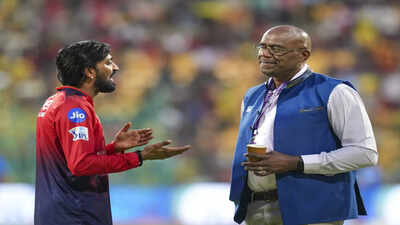
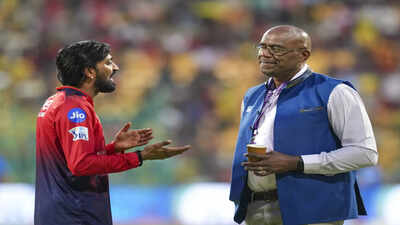
NEW DELHI: Harbhajan Singh, Aakash Chopra and Navjot Singh Sidhu have come under severe criticism on social media for their commentary [Hindi] in the ongoing Indian Premier League (IPL). This is not the first time that fans have advocated for a better product from the broadcaster. Ex-West Indies player Ian Bishop sits on the other end of this divide.While addressing a larger point, former Kolkata Knight Riders (KKR) Team Director and sports administrator Joy Bhattacharjya wrote on X, “I am all for the credit given to Ian Bishop for the research he puts into the junior cricketers.”
“Demanding why other commentators are not picking up such stories is irrelevant. I am asking you, as cricket lovers, to also go and read and celebrate the reporters who make Bishop and other commentators look good on air with great reporting from the ground. You giving them credit does not make Bish look bad, I am sure he would welcome it as a great commentator, and more importantly, as a very decent man,” he continued.Bishop, who was recommended as a commentator by Michael Holding to Channel 4, doesn’t shy away from admitting that much of the credit does go to the journalists on the ground who chase these stories.“As a broadcaster and as a human being… I am interested in numbers, but numbers are widely available. What I am interested in is the person behind the cricketer. So if I come to a tournament like this, I want to research every player that is in the league,” he had told TimesofIndia.com on the sidelines of the ILT20.“I want to know who their parents are, I want to know what job they had, I want to know how they got into the game. I believe the public deserves to know this for several reasons. The 13-year-old watching who doesn’t have the availability of funds, I want to be able to say to him or her, you too can make it, even if you don’t have access to resources,” he had continued.Bishop revealed he picked up the chops of the gig from Holding, Gary Francis at Channel 4 and Michael O’Dwyer at Trans World International, while Tony Cozier remains his role model.
I want to say thanks to all of you gentlemen from the media, particularly the written press, who do all these profiles on players that feed information to me as a commentator that I would not otherwise have known.
Ian Bishop
The 58-year-old played 43 Tests for the West Indies over a nine-year career. Ever since stepping away from the cricket pitch in 1999 due to injuries, he opted against becoming a coach, preferring to pick up the microphone instead. If not, he would have turned into a teacher.“I want to be able to inform what this player has done. So it takes me a lot of time. In fact, I was with our analyst asking if there is any AI that could help me cut down my research time. Because I spend, to the chagrin of my wife and children, far too much time preparing for a game,” said Bishop to this website.“But I don’t want to do a disservice to the people watching and listening by not knowing a player or what I am talking about,” he continued.
As far as delivery is concerned, Test match cricket is a slower pace; you have time for storytelling. Whereas T20 cricket, on the other extreme, has to provide that energy most of the time.
Ian Bishop
He then thanked the media for helping him do his job better, just as Bhattacharjya referred in his post.“I want to say thanks to all of you gentlemen from the media, particularly the written press, who do all these profiles on players that feed information to me as a commentator that I would not otherwise have known.”Another aspect of the commentary role is beyond the research, and it comes in the form of delivery. There is Martin Tyler’s “Agueroooo” from the 2012 English Premier League, which saw Manchester City win the title with seconds to spare. There is also the “Dhoni finishes off in style!” described by Ravi Shastri as India won the 2011 ODI World Cup.Bishop believes the delivery hinges on the format, and sometimes even silence does a good job.“As far as delivery is concerned, Test match cricket is a slower pace; you have time for storytelling. Whereas T20 cricket, on the other extreme, has to provide that energy most of the time. And that’s why even if I have to act it out, I want to bring that energy because of this format of the game.“There are times when I prefer not to speak, to be honest with you. And then the producer comes in your ear, ‘Are you not saying anything? You’re not working today?” he stated.Does he, or other commentators, prepare such lines or rehearse these moments?“If I know a guy’s backstory, I’m prepared with that before the game. And if I know the game is coming down to a crunch moment… Ajesh Ramachandran, who works at the ICC [an executive producer]… in 2016, he was the first one to say, please prepare for moments, whether it’s a half century, whether it’s a five-wicket haul, with something. Because that moment will live on for eternity. And so I try to do that.
Poll
How do you feel about the research content provided by commentators?
“But I also find that the best commentary is having a sort of an idea of the moment, but more ad-libbing those through bullet points. Because if you write a script, it just sounds very well read. Whereas reacting to the moment with a little bit of previous information, I think, is the best way to go,” he reasoned.At this juncture in the IPL commentary divide, he also shed light on gaining perspective on criticism, which might resonate with the current crop of under-fire IPL commentators, from legendary commentator Richie Benaud.“When there was a vote for the best commentator, and he won, he said, ‘Don’t worry about that. I didn’t get all the votes. This person, this person, got some votes, so not everyone loved my style. And [there’s a] part of the market that likes volume, they like words, they like high-pitched calling to excite them, and there’s another part of the market that likes calm,” he told The Cricket Monthly magazine.