


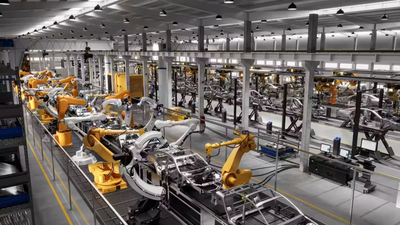
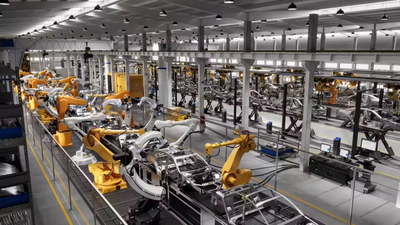
When it comes to India’s economic future, few are as optimistic — and as candid — as Himanshu Shah. For the North Carolina investor, the country’s greatest opportunity lies not in rhetoric, but in execution. Speaking at a panel during the Indiaspora Forum 2026 on the outskirts of Bengaluru on Monday, the founder of Raleigh-based Shah Capital argued that India’s real promise can be seen in the industrial and skills infrastructure taking shape beneath the surface, even if the broader picture remains uneven. Pointing to massive manufacturing clusters and the government’s growing support for new industrial zones, Shah said the deeper story is one of capacity building. “India is full of ideas. It’s the execution of it… that is going to play a bigger role over here,” Shah said. “You also have just amazing improvement going underneath on the skills improvement. Because again, a lot of manufacturing has not been in India.” He linked that manufacturing gap to India’s continued colossal dependence on Chinese imports, even as its entrepreneurial energy and young workforce continue to grow. India, he said, still runs a significant trade deficit of over $100 billion with China despite China’s 5X higher per capita income, a sign of the skill and production advantages China has built over time. At the same time, Shah stressed that India is making progress. There “is an amazing improvement going on that front,” he said, adding that even if “it doesn’t look great on the surface, but underneath, I’m very excited.” The panel, moderated by Indiaspora founder M.R. Rangaswami, also featured Ravneet Mann, Partner at Stride Ventures, and Sridar Iyengar, Founder of 360plus. Speaking about capital allocation and public policy, Shah argued that India’s government should think much more aggressively about seeding future industries through targeted public-private partnerships. “First of all, let’s talk about the fund that was set up by the Indian government in 2016. It was a billion-dollar fund, and that resulted in over 200,000 start-ups in India. Recently, another billion-dollar plus fund was set up for AI and Deep Tech,” Shah said. “Frankly, Indian government should be setting up 10 to 20 of that. Marine technology, space, drones, machine tools, material science, the list goes on and on.” For Shah, such investments are not just about financial returns. They are also a way to create structured collaboration between the state, private capital, and the Indian diaspora.“And bringing that public and private partnership on that, the diaspora can truly contribute, including myself,” he said. He also highlighted what he described as an “industrial renaissance” at the state level, with some Indian states using land incentives and sector-specific support to attract manufacturing projects. Bihar, Uttar Pradesh, Odisha, and Gujarat, he said, are among the states beginning to experiment with such models. To illustrate the scale of the opportunity, Shah pointed to titanium dioxide, a material used in products such as paint and coatings. He gave an example of a potential large company to show how India could replace imports with domestic production if the economics and policy support aligned. Shah noted that “India’s demand for titanium dioxide is 400,000 metric tons. And … the country only produces 70,000-80,000 [tons]. And by the way, it imports the rest from China, if you look at the cost of making that today assuming you have a free land in some of these states that I’ve mentioned, the project becomes very economical and interesting.” That example, he suggested, offers only a small glimpse of what could be possible if India becomes truly more supportive of entrepreneurs and manufacturers. “So, this is just a slip of what is possible in India if the government starts really working for the entrepreneurs instead of being an obstacle,” he said. But Shah’s optimism came with a familiar caveat. He acknowledged that India’s bureaucracy remains a major drag on enterprise, and he did not soften that criticism. “It is still there,” he said. “It is very frustrating. You need ~27 forms to open a bank account in India still today in 2026. Doesn’t make any sense. So, there are a lot of things that this country needs to work on. But I see the signs of it.” In the closing part of the discussion, Shah widened the lens beyond investing and manufacturing to the broader role of the diaspora. Asked what he would want overseas Indians to do in engaging with India, he pointed to remittances, philanthropy, and early-stage investment, but returned most strongly to one theme: skills. He suggested that India should actively draw on the expertise of older, often retired engineers and professionals across the diaspora to help upgrade the country’s industrial base.“I think one area, and philanthropy, actually, on top of that, there’s job skills. And I really want to go back to that,” Shah said. “If there is a public and private partnership, maybe as a 2047 initiative, that you can actually bring those people and give, you know, whether it’s in engineering, in science, in manufacturing.” He added that many Indians who moved abroad built technical careers and now have precisely the experience India needs if it wants to manufacture more sophisticated products at home.“A lot of these people that moved out of India were engineers. And there are a lot of them in their 50s, 60s, and 70s are retired and looking for something to do,” he said. “Because this country needs that skill set to make good quality products.” For Shah, the future of India’s growth story will depend not only on government policy or investor appetite, but also on whether the country can connect capital, skills, and execution. Events that bring together diaspora leaders, investors, and policymakers, he suggested, can help make that happen. “And I think an event like this will play a big role in making something happen on that front,” he said, referring to the Indiaspora Forum 2026.(By arrangement with The American Bazaar)