




Need money, but don’t want to sell what you own? That’s where borrowing against an asset can come in handy. You might think of gold, home or personal loan, but one asset you may not immediately think of is sitting in your demat account: your shares.That is, loans against shares (LAS), which allow investors to unlock cash from their stock holdings without actually selling them. The shares are pledged to the lender as security, while the borrower continues to hold them. For someone who needs funds for a short period but does not want to exit a long-term investment, that can sound like an attractive option.This is the basic idea behind a loan against shares. Instead of exiting your investments to raise cash, you pledge eligible shares to a lender and borrow against their value, while continuing to hold them.The idea seems simple. The fine print is where it gets interesting – how much can you borrow, what happens when the market falls, when can a lender invoke the pledge, and what happens to your dividends and taxes?So, from guidelines to legal provisions, here are 10 things to know about LAS.
1. What is a loan against shares?
A loan against shares is a secured loan in which an investor pledges eligible shares held in a demat account to a bank or NBFC. The shares are not sold; they serve as collateral for the borrowing.Central securities depository, Central Depository Services (India) Limited (CDSL) defines it as, “a secured credit facility in which a borrower obtains a loan by pledging securities such as equity shares, mutual fund units, bonds, etc., as collateral, without selling the underlying investments.”Thus, in simple words, the investor gets access to cash without exiting the investment, while the lender gets security against the loan.

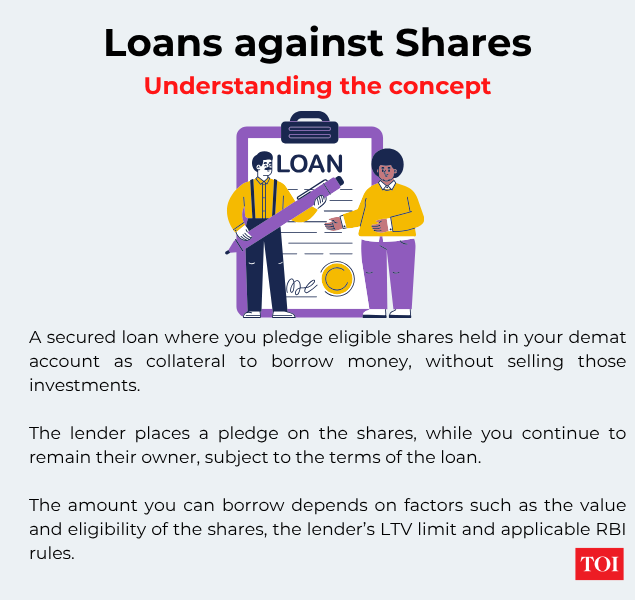
The concept
2. How much can be borrowed?
The lender does not generally lend 100 per cent of the market value of the pledged shares. It applies a loan-to-value, or LTV, ratio.The amount one can borrow depends on the value and type of securities pledged, the lender’s policy and the applicable RBI limits. For individual borrowers, the RBI has raised the overall ceiling against eligible securities from Rs 20 lakh to Rs 1 crore, but banks have their own policies.There is also a loan-to-value (LTV) limit, which determines how much of the value of the pledged shares can actually be borrowed. For listed shares and listed convertible debt securities, the current RBI ceiling is 60%. In simple terms, if you pledge eligible listed shares worth Rs 10 lakh, the regulatory ceiling would allow a loan of up to Rs 6 lakh, subject to the bank’s own policy and other applicable conditions.The two limits work together: Rs 1 crore is the overall ceiling, while LTV determines how much can be borrowed against the value of eligible listed shares. So someone with Rs 2 crore worth of eligible shares cannot borrow Rs 1.2 crore against them.RBI also requires banks to monitor the LTV on an ongoing basis because the value of shares can change after the loan is sanctioned. If the pledged shares fall sharply, the outstanding loan does not automatically fall, but the LTV rises and the borrower may have to restore the required collateral cover under the lender’s terms.
3. Is there a defined borrowing tenure?
There is no single RBI-mandated tenure for a loan against shares. The repayment period depends on the lender and the product.Some LAS facilities are structured as term loans with a defined repayment period, while others operate more like a demand/overdraft facility where the borrower can draw and repay within an approved limit.The important point is that the pledge remains in place until the borrowing and other dues are settled, subject to the terms of the agreement.
4. Can one pledge any shares?
Not necessarily. Technically, securities can be pledged, but whether a particular security is accepted depends on the pledgee.Lenders can therefore maintain approved lists and apply different haircuts depending on the stock. Liquidity, volatility and concentration can matter because the lender needs to be able to realise the security if the borrower defaults.This means an investor should not look only at the total value of the demat portfolio. A Rs 10 lakh portfolio does not necessarily translate into a Rs 10 lakh eligible collateral pool.

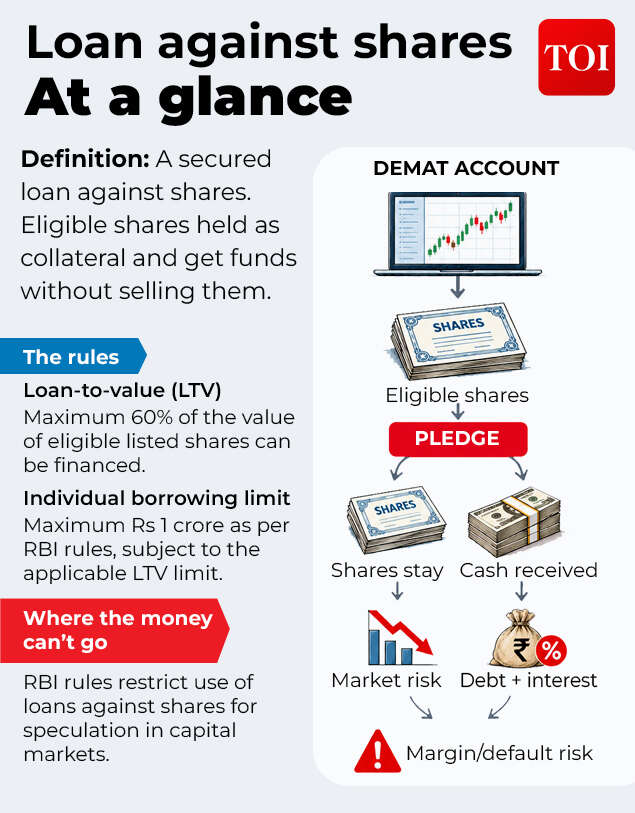
Understanding: At a glance
5. How to get a loan against shares?
The process is broadly similar to taking other secured loans.Step 1: Check whether your shares are eligible.Lenders typically have an approved list based on factors such as liquidity, volatility and marketability.Step 2: Check how much one can borrow.The lender applies the applicable loan-to-value ratio to the value of the eligible shares. The amount can also change if the market value of the pledged securities changes.Step 3: Apply and complete the lender’s checks.The lender assesses the borrower and the securities, and sets the interest rate, repayment structure and other terms according to its policy.Step 4: Create the pledge.The eligible shares are pledged in favour of the lender through the demat system. The borrower does not sell the shares and continues to hold the beneficial interest while the pledge remains in place.Step 5: Receive the loan.Once the pledge and other formalities are completed, the lender disburses the loan or makes the approved credit facility available.
6. What happens if the share price falls sharply?
This is the biggest risk borrowers need to understand.The collateral here is not static. Unlike a fixed-value asset, the market value of shares can change every trading day.“The key difference is that this loan moves with the market,” explained BankBazaar CEO Adhil Shetty. If the pledged shares rise in value, the collateral cover improves; if they fall, the gap between the outstanding loan and the value of the pledged securities can narrow. The borrower may then have to provide additional securities, bring in cash or repay part of the loan, depending on the lender’s terms.
Because share prices move, it’s worth remembering that the amount you can borrow against them can shift too, not just at the start but through the life of the loan.
Adhil Shetty, CEO, BankBazaar
That is why the amount a borrower can raise is not simply a function of how much the shares are worth on the day the loan is taken. Lenders apply LTV, against eligible securities and may also consider factors such as the liquidity and volatility of the shares.Say you pledge shares worth Rs 10 lakh against a Rs 5 lakh loan. The shares then fall 30 per cent, taking the collateral value to Rs 7 lakh. Your debt, however, remains Rs 5 lakh.The lender may then require you to restore the required collateral cover by pledging more securities, bringing in cash or repaying part of the loan.“The key difference is that this loan moves with the market,” Shetty explained. “As the shares gain or lose value, so does the amount a lender is comfortable lending against them.”For borrowers, the practical lesson might be to leave a cushion rather than borrow right up to the maximum available amount.
7. What if the borrower defaults?
If the borrower fails to repay the loan or triggers an event of default under the loan or pledge agreement, the lender can enforce its rights over the pledged shares. Under the law governing pledges, the lender can, after giving the required notice, sell the pledged securities to recover the outstanding dues. The borrower can also remain liable for any amount that is still outstanding after the value realised from the shares is adjusted against the debt.V Anush Rajan, Advocate on Record, Supreme Court of India, said a lender as a pawnee has two broad options: it can retain the pledged shares as security and sue the borrower for recovery of the debt, or, after giving the required notice and an opportunity to repay, sell the shares or appropriate them towards the outstanding dues. If the shares realise less than the amount owed, the lender can sue the borrower for the remaining amount after giving credit for the value recovered from the securities.“The shares when pledged are liquid assets in the hands of the lender,” Rajan said, further explaining the case of default that, “When these shares are acquired by the bank following a pledge, and not sold in the open market, any future upward scaling of the shares is not given credit to the borrowers. So one must be extremely circumspect with pledging of shares against loan.”
Reading the terms of the pledge is very important. More often than not these types of loan against shares carries high default penalties being imposed.
V Anush Rajan, Advocate on Record, Supreme Court
For borrowers, the important point is that default does not simply mean losing the shares. Depending on the agreement and the circumstances, the lender may enforce the pledge and still pursue the borrower for any shortfall.
8. Any tax treatment or benefits specific to LAS?
The first distinction is between pledging shares and selling shares.Creating a pledge does not, by itself, amount to an ordinary sale of the shares. So the investor does not ordinarily trigger capital gains merely by taking the loan.The tax treatment of the interest is a separate question and depends on the purpose for which the borrowed money is used and the relevant provisions. There is no blanket tax deduction simply because the loan is secured against shares.“If the borrowed funds are used for business or to earn taxable income… the interest may be allowable as a deduction under the appropriate provisions, subject to conditions,” said CA Chandni Anandan, Tax Expert at ClearTax.The tax position can become more consequential if the lender eventually sells the shares after a default. If the borrower defaults and the lender invokes the pledge and sells the shares, the resulting capital gain or loss is considered in the hands of the borrower, who owns the shares.Broadly, the calculation compares the amount realised from the sale with the applicable cost of acquiring the shares and eligible transfer expenses. Whether the resulting gain or loss is short-term or long-term depends on the holding period and the rules applicable to the securities.As CA Anandan explained, “If the lender invokes the pledge and sells the shares to recover the outstanding loan, the transaction is treated as a transfer of a capital asset in the hands of the borrower.” Thus, if pledged shares are ultimately sold, the investor should retain the contract note and sale statement from the broker or lender to report the transaction correctly in the ITR.
The optimal choice (between selling an pledging for loan depends on the investor’s holding period, tax regime, expected returns, risk tolerance and the purpose of the funds.
CA Chandni Anandan, tax expert at ClearTax
For example, if an investor bought shares for Rs 4 lakh and the lender later sold them for Rs 3 lakh after a default, the investor would broadly have a Rs 1 lakh capital loss, subject to the applicable tax rules.
9. What happens to dividends when shares are pledged?
Pledging shares does not normally mean giving up the benefits attached to them. SEBI’s investor guidance says that securities pledged with a lender remain blocked in the investor’s account and that the pledgor continues to receive the corporate benefits on those securities.That means an investor who pledges shares can generally continue to receive dividends and other corporate benefits while the pledge remains in place. The pledge itself is not a sale of the shares.The position changes if the lender invokes the pledge. Under SEBI’s framework, once a pledge is invoked, the pledgee is recorded as the beneficial owner of the securities.So the simple distinction is that pledging the shares does not ordinarily take away the investor’s dividends.
10. What to check before pledging?
Before taking a loan against shares, borrowers should look beyond the headline interest rate.Know the rules: Check the regulatory limits and conditions before pledging shares. RBI caps loans to individuals against eligible securities at Rs 1 crore at the banking-system level. Within this, only up to Rs 25 lakh may be granted for acquiring securities in the secondary market.Check the LTV: Find out how much the lender will actually lend against each security. As per RBI, the LTV for listed shares and listed convertible debt securities is capped at 60% but lenders may choose to keep the rate different under the RBI limit.Check the eligible list: Not every stock in your portfolio may qualify, and the lender may apply different haircuts. Also, it’s not a standard list and varies from lender to lender.Understand the margin trigger: Ask exactly when you would have to pledge more shares, bring in cash or repay part of the loan. Kalpit Khandelwal, partner, Aekom Legal, explained it as this is where borrowers can underestimate the risk. “A sharp fall breaches the lender’s margin requirement,” he said, adding that the borrower may have to top up collateral or repay quickly. “Margin calls arrive when markets are weakest, which is exactly when raising cash is hardest.“Read the default clause: Understand the notice, invocation and sale process before signing. “The pledge agreement matters more than the interest rate. Read it before you sign,” Khandelwal added.
The pledge agreement matters more than the interest rate. Read it before you sign.
Kalpit Khandelwal, partner – Aekom Legal
Calculate the full cost: Interest is only one part. Check processing, pledge, unpledge and penal charges as well.Keep a liquidity buffer: If a market fall triggers a margin requirement, you should not be forced to sell investments at the worst possible time simply to keep the loan alive.Know your tax position: The tax treatment can depend on how the borrowed money is used and what eventually happens to the pledged shares.Ultimately, a loan against shares offers something many investors may find attractive: access to cash without immediately giving up an investment. However, the shares remain exposed to the market while the debt remains a liability.That is the trade-off borrowers need to understand before turning a stock portfolio into collateral.