


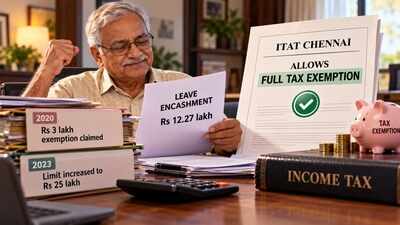
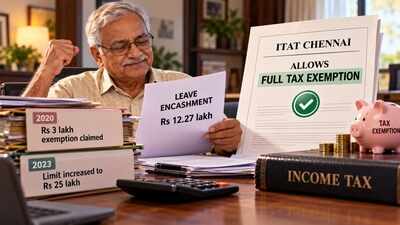
You retire and get leave encashment, a part of which is exempt from tax. You file your income tax return claiming the exemption, but later the exemption limit is hiked. Are you entitled to the benefits of the enhanced leave encashment exemption limit?In one such case, the Income Tax Appellate Tribunal (ITAT), Chennai has given its decision in favour of a retired bank employee.The case involved a question that has come up before several tax tribunals: whether the higher leave-encashment exemption introduced in 2023 can also benefit employees who retired before that change, particularly when their tax proceedings were still being pursued.
What the case is about
The taxpayer had retired from a bank during the financial year 2019-20. On superannuation, he received Rs 12,27,232 as leave encashment.When he filed his income tax return for assessment year 2020-21 on September 10, 2020, he claimed Rs 3 lakh as exempt under Section 10(10AA)(ii) of the Income Tax Act. After claiming that exemption, he declared a total income of Rs 24,36,260.Also Read | US-based daughter files case against parents seeking share in properties; Karnataka HC rejects her ‘ancestral’ claim, saying they were father’s separate assets, not coparcenary propertyAt that time, the exemption ceiling for leave encashment applicable to non-government employees was Rs 3 lakh. The man accordingly claimed exemption of Rs 3 lakh when he filed his income tax return.Subsequently, a CBDT Notification No. 31/2023 dated 24 May 2023 increased the exemption limit for non-government employees from Rs 3 lakh to Rs 25 lakh.The notification stated that it would come into force from 1 April 2023, while its Explanatory Memorandum records that no person would be adversely affected by giving retrospective effect to the notification.That change prompted the man to seek the benefit of the higher exemption against his earlier claim. Since he had received only Rs 12.27 lakh, he sought exemption for the entire amount, rather than the Rs 3 lakh he had originally claimed.His return had already been processed by the Centralised Processing Centre (CPC), Bengaluru, under Section 143(1) on December 13, 2020. The CPC had allowed the Rs 3 lakh exemption and brought the balance leave encashment to tax.The man subsequently appealed against the CPC’s order before the Commissioner of Income Tax (Appeals) on January 7, 2026. The CIT(A), however, rejected his claim on February 25, 2026. It held that the notification applicable to assessment year 2020-21 was the earlier notification that prescribed the Rs 3 lakh ceiling.The man then approached the Chennai ITAT.Also Read | Man deposits Rs 85.3 lakh received as cash gifts from wife, relatives; income tax calls it unexplained and sends notice, but ITAT Chennai accepts gift deeds and gives relief
Why did ITAT rule in favour of the retired employee?
The key question before the ITAT was whether the enhanced limit could benefit an employee who had retired before 1 April 2023. The Tribunal answered this in the affirmative.Before ITAT, it was argued that the 2023 enhancement was beneficial and curative. Although the notification specified April 1, 2023 as its effective date, the taxpayer argued that its explanatory memorandum and the nature of the amendment supported its application to his case.The Tribunal began by identifying the central issue: whether the man was entitled to exemption up to Rs 25 lakh under Section 10(10AA)(ii), or whether the exemption for his assessment year had to remain restricted to Rs 3 lakh.The bench noted that Section 10(10AA)(ii) already provided an exemption for leave encashment received by non-government employees, subject to a monetary ceiling notified by the Central Government.According to Amit Ganatra, Executive Director, Khaitan & Co, ITAT’s reasoning was principally founded on the beneficial and remedial character of the CBDT notification.“The ITAT noted that the notification did not create a new exemption or introduce a new class of eligible taxpayers; rather, it enhanced the monetary ceiling of an exemption which was already available to non-government employees under section 10(10AA)(ii),” Ganatra tells TOI.Also Read | 83-year-old woman got Rs 12.28 lakh after son’s death, but sought Rs 15,000 maintenance from college-going granddaughter and a share of family pension from son’s widow; Kerala HC rejects both claimsThe earlier ceiling of Rs 3 lakh had remained unchanged for almost 20 years, despite substantial changes in salary levels and the economic environment.“ITAT therefore viewed the enhancement to Rs 25 lakh as a measure intended to update and rationalise an existing provision and to mitigate the hardship arising from the continued application of an outdated monetary limit. ITAT also considered it inequitable to deny the benefit of the enhanced ceiling to employees merely because their retirement preceded the date on which the notification was issued, particularly where the benefit was otherwise intended to address the inadequacy of the earlier limit,” he said.A significant factor considered by the ITAT was the Explanatory Memorandum accompanying Notification No. 31/2023. While the notification itself provides that it shall come into force from 1 April 2023, the Explanatory Memorandum specifically states that “no person is being adversely affected by giving retrospective effect to the notification”.ITAT held that provisions intended to confer a benefit and remove hardship should be interpreted liberally and, in appropriate cases, applied retrospectively, particularly where doing so did not adversely affect any vested right of the Revenue.The bench also said the absence of an express retrospective clause could not by itself settle the issue when the amendment merely enlarged an existing benefit. In its view, the remedial nature of the change had to be considered.Ganatra explained that ITAT relied on this to ascertain the remedial intent underlying the enhancement. In such circumstances, the absence of an express provision giving retrospective effect was not considered determinative, particularly since the notification merely enlarged the monetary limit of an existing exemption.ITAT also noted the settled judicial principle that beneficial and curative amendments may be applied in appropriate cases to advance the cause of justice.Ganatra says that another important factor was the judicial consistency emerging from various ITAT benches.“The Chennai Bench referred to a number of earlier decisions which had similarly allowed the enhanced Rs 25 lakh limit in cases involving earlier retirement years. ITAT therefore considered its conclusion to be supported by a developing line of coordinate-bench decisions,” he said.After considering the statutory provision, the notification, the explanatory material and the earlier ITAT decisions, the Chennai ITAT held that the man was entitled to the enhanced Rs 25 lakh limit.Because his leave encashment was Rs 12,27,232, the entire amount was below the enhanced ceiling and therefore eligible for exemption.The Tribunal consequently set aside the restriction imposed by the CPC and the order of the CIT(A). It directed the Assessing Officer to allow the exemption claimed by the man.Also Read | Man opted for VRS after employer shut plant, got Rs 65.21 lakh and reported it as advance salary in ITR; Section 89 relief was denied, but ITAT Pune later ruled it a non-taxable capital receipt
Significance for taxpayers
The Khaitan & Co expert says that for taxpayers, the ruling is particularly relevant to non-government employees who retired before 1 April 2023 and whose exemption for leave encashment was restricted to Rs 3 lakh.“The decision provides judicial support for the position that the enhanced exemption limit of Rs 25 lakh may also be available in respect of such earlier years,” he says.However, he cautions that the issue is not free from judicial divergence.“In Purnendu Shekhar Sinha v. Union of India, the Patna High Court, while examining the constitutional validity of the distinction under section 10(10AA) between employees of the Central/State Governments and employees of other establishments, held that such classification was not discriminatory and proceeded on the basis that 1 April 2023 is the operative date for the enhanced exemption limit,” he says.“This judgement was not brought to the notice of the Chennai ITAT. Accordingly, while the Chennai ITAT ruling strengthens the case for retrospective application of the enhanced limit, the issue cannot, at this stage, be regarded as conclusively settled for all taxpayers,” he adds.