


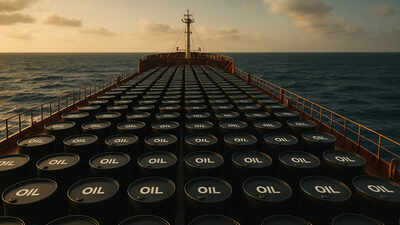

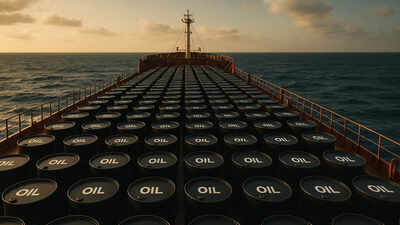
The Middle East conflict and the closure of Strait of Hormuz led to the biggest oil supply shock and disruption in recent times. Global oil supply fell by 13.6 million barrels per day, which is around 13% of the 2025 global output according to the latest report by Asian Development Bank. In fact, the losses exceeded every previous oil crisis. By comparison, the 1973 Arab oil embargo and the 1990 Gulf War removed 4–6 million barrels per day at their peaks, and the initial loss following the Russian invasion of Ukraine in 2022 was about 1 million barrels per day.Yet as ADB notes in its report – despite this unprecedented supply shock, crude oil prices did not reach levels seen during the 1973 Arab oil embargo or even the 1990 Gulf war, if one were to inflation-adjust the prices.

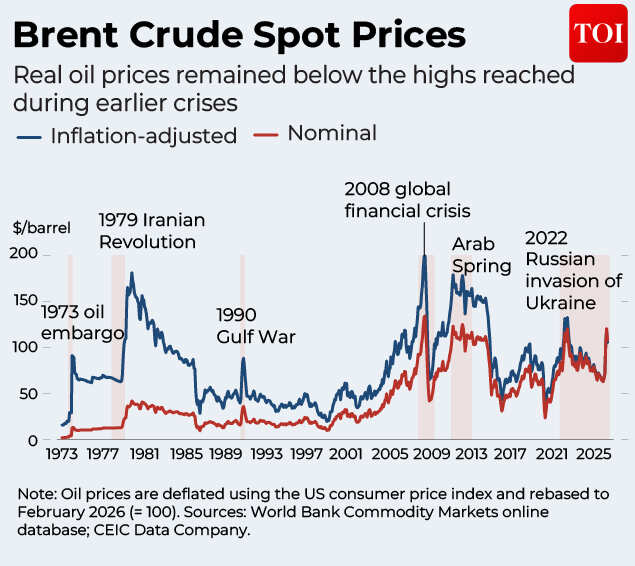
Brent Crude Price Trends: Comparison with previous crises
Brent crude prices in the spot market briefly surged to around $144 per barrel before easing as markets adjusted. Why did crude oil prices not rise as much as expected and what will be the likely trend in future? Let’s take a look:
What has changed this time?
The market’s fundamental structure is different, and importantly, more resilient.During the 1970s, crude benchmarks rose nearly tenfold by the decade’s end and stayed elevated for years. Today’s moves have been faster but less persistent. The market structure has fundamentally changed, says Pranav Master, Director, Crisil Intelligence.In the 1970s, OPEC controlled more than half of global production, tightening supply and sustaining price pressure. Now, non – OPEC sources – including US shale as well as production from Brazil, Russia and Canada – can ramp up output within months, blunting the length and intensity of price spikes.Sourav Mitra, Partner – Oil & Gas, Grant Thornton Bharat believes that the global oil market has achieved a profound structural shift in resilience since the supply shocks of the 1970s. “This transformation is rooted primarily in global macroeconomic diversification: the oil intensity of global GDP has declined by over 50% over the last five decades. Today’s advanced and developing economies are far less reliant on crude oil per unit of economic output due to the dominance of service-oriented sectors, stringent vehicle fuel efficiency mandates, and alternative energy integration across power generation,” he explains.

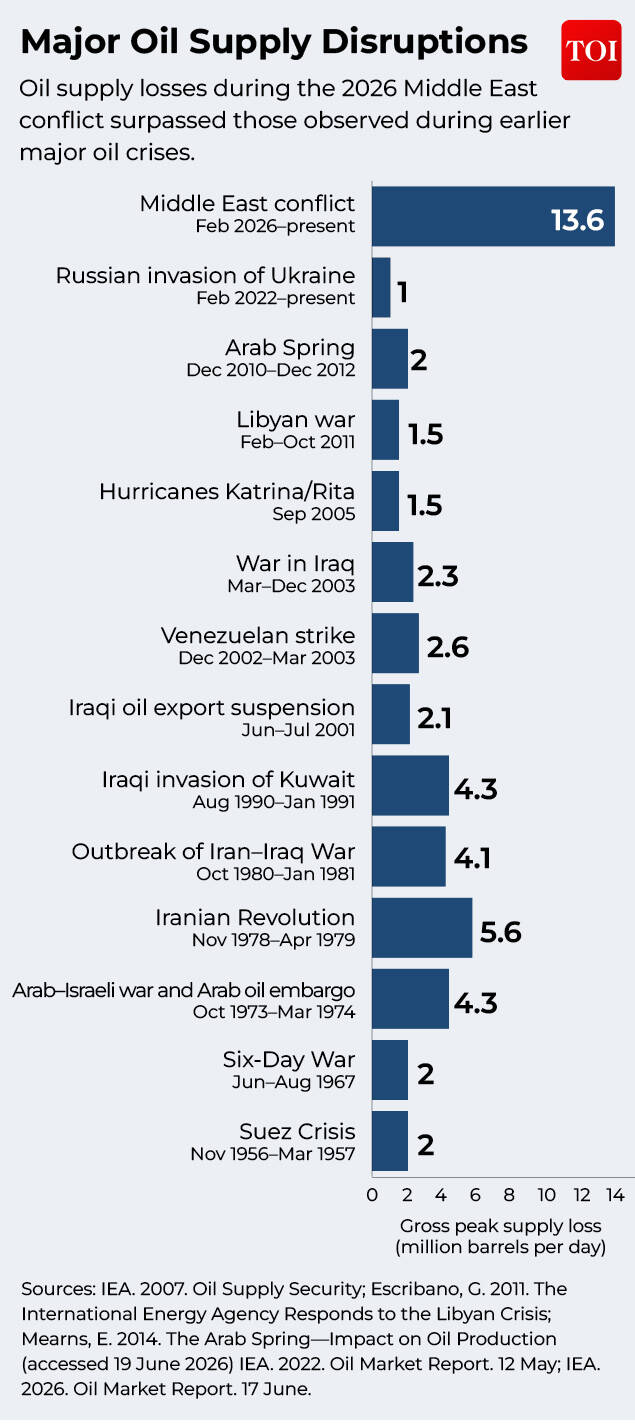
Major Oil Supply Disruptions: Where oil supply losses stand
The ADB report notes that not all Middle Eastern oil exports were lost. For example, some producers bypassed the Strait of Hormuz, opting for alternative export routes. Saudi Arabia increased its shipments from Red Sea terminals and the UAE exported through Fujairah. “This rerouting mitigated the supply shock. Finally, higher output and exports from producers outside of the Middle East offset some losses. US crude exports reached a record 5.6 million barrels per day in May, while a temporary waiver of sanctions on Russian oil shipments further widened access to alternative supplies and helped redirect crude to affected importers,” the ADB report says.And then there is the supply side diversification globally. Countries are no longer dependent on just OPEC members for their crude stock.“A greater share of global crude production now comes from non-OPEC producers, reducing reliance on a smaller group of suppliers and improving the market’s ability to respond when prices rise,” Pranav Master tells TOI.Adding to this broader shift is China’s rapid domestic energy pivot. “As the world’s largest importer, China’s aggressive domestic rollout of electric vehicles (EVs) and high-speed rail networks has substantially dampened its incremental demand growth. To further bolster these aspects, China now also had massive crude oil reserves which allowed it to act as a balancing force to the factors that were pushing crude oil prices upwards,” says Sourav Mitra.
Role of Strategic Reserves
Strategic petroleum reserves further strengthen this buffer. IEA member countries are required to maintain emergency oil stocks of at least 90 days of net imports. What this does is simple: it enables coordinated releases during major disruptions. This helps in easing immediate supply pressures and also calms the market sentiment.In this case too, strategic petroleum reserves, commercial inventories, and coordinated IEA stock releases played a critical stabilizing role in preventing a much sharper oil price spike during periods of supply disruption.“By rapidly injecting additional barrels into the market, these mechanisms helped offset supply deficits, ease market tightness, and reassure traders that physical shortages could be managed. The historic 2026 coordinated action by IEA members, which made an unprecedented 400 million barrels of emergency oil stocks available, provided vital incremental supply to counter severe supply losses stemming from the Middle East conflict and the closure of the Strait of Hormuz,” explains Sourav Mitra.

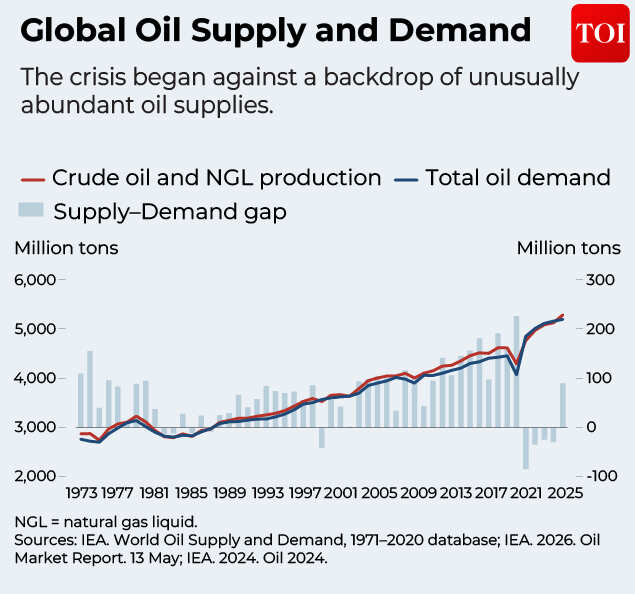
Crisis began against abundant oil supplies
In fact, according to Mitra, building upon the precedents of the 2022 interventions, this 2026 response stands as the largest coordinated release in IEA history.Not just that, elevated commercial inventories also acted as a buffer against short-term disruptions, reducing panic buying and speculative price pressures.“Together, these inventory-based interventions strengthened market confidence and demonstrated that strategic stockpiles remain a key tool for energy security and price stabilization during geopolitical crises,” Mitra says.

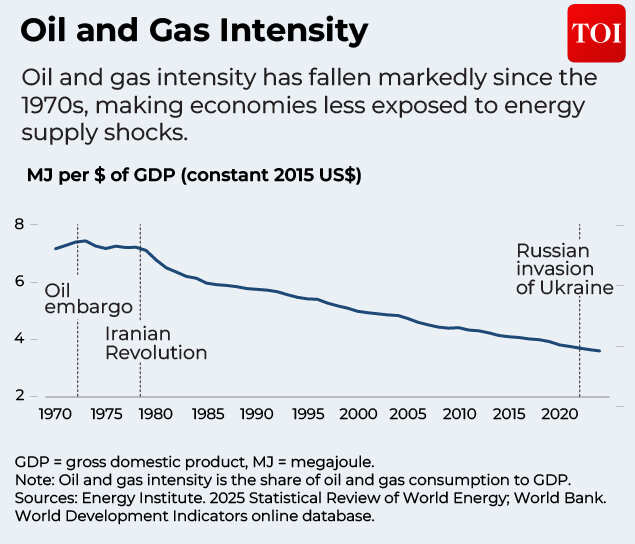
Economies less exposed
According to Pranav Master, during the Russia – Ukraine conflict, IEA member countries jointly committed to release 240 million barrels – the largest coordinated action at the time – helping to ease immediate fears about tight supplies. As non – OPEC output rose, Russian exports were rerouted, and global demand softened, the market gradually moved back toward balance.“Still, these releases are meant to buy time, not replace the underlying supply. Longer – term stability depends on the recovery of physical supply and the market’s ability to rebalance through shifts in production, trade routes, and demand,” the Crisil expert cautions.
China acts as a shock absorber, market expectations help
Analysts also see China’s muted oil demand as a factor that helped. Why did that happen? Because China’s quiet utilization of its own domestic stockpiles provided a massive secondary shock absorber.“By counter-cyclically drawing down its expansive domestic inventories, China voluntarily curbed its seaborne import demand during critical weeks. The combined force of official Western IEA liquidity injections and non-Western commercial inventory management prevented localized panic buying, proving that modern global inventory coordination extends far beyond the traditional IEA framework,” says Mitra.The ADB report points to another interesting trend: While spot prices surged as refiners competed for immediate supplies, longer-dated futures rose by far less. “Through April and May, Brent spot prices remained above $100/barrel, yet futures contracts for delivery in late 2026 traded below $100 and declined further into 2027. With the far end of the curve pricing in normalization, holders had little incentive to stockpile barrels for later resale, so oil flowed into the spot market rather than into storage, easing pressure on prompt supply,” it explains.
Is there no fear of oil touching $200?
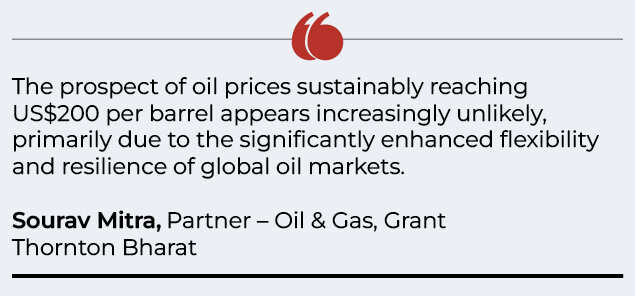
The Strait of Hormuz crisis, while exposing supply chain vulnerabilities and chokepoints, also highlighted the ability of major economies to quickly adapt to the situation to ease pressures. Hence, analysts don’t think that the chances of crude oil prices touching $200 per barrel due to future disruptions are real.“The likelihood of crude oil prices reaching and sustaining levels above $200 per barrel has decreased as global oil markets have become more flexible and resilient. Moreover, periods of elevated oil prices tend to accelerate the adoption of alternative technologies such as green hydrogen and electric vehicles, reducing dependence on oil. This could lead to earlier than expected commercial viability of these technologies,” says Pranav Master.

Crude above $200?
“While crude oil markets can still experience sharp short – term spikes during severe physical supply disruptions, a $200-per-barrel environment is less probable,” he adds.Over the past two decades, the emergence of US shale production, diversified crude and LNG trade flows, expanded strategic petroleum reserves, and improved supply chain infrastructure have collectively strengthened the market’s ability to respond to disruptions. “Another reason extreme oil price spikes are becoming harder to sustain is the growing flexibility of major consumers, particularly China. China’s strategic transition from an aggressive spot buyer to an inventory optimizer. Rather than chasing expensive seaborne cargoes during spikes, China’s utilization of its vast commercial storage networks to temporarily pull back from the global purchase market removes immense pressure from the spot trade,” says Sourav Mitra.
What if the Hormuz closure extended for longer?
But even as the global economy is notably less vulnerable to oil supply shocks, the length of the conflict and closure of Hormuz are also important.“The factors restraining prices so far may not hold if the disruption proves more prolonged. Buffers are already thinning on several fronts. Global inventories fell by about 330 million barrels from March to May as governments and refiners drew down strategic and commercial stocks. Floating storage has also declined from its preconflict high, reducing one of the market’s key sources of short-term flexibility. Demand-side relief may also fade,” the ADB report says.“As the conflict recedes, refiners and governments will move to rebuild depleted inventories, possibly to above pre-conflict levels as a precaution against renewed shocks,” the report adds.


Diversified world supply chain
But a broader disruption would also lead to a long-term readjustment, believe experts.If for example, Hormuz had been closed for six months in a go, experts say the shock would have extended beyond a temporary energy shock and accelerated structural shifts in the global energy system. “Faced with sustained supply shortages, major importing economies in Europe and Asia would be compelled to implement emergency demand-management measures, prioritize critical industries, and fast-track energy efficiency initiatives. More broadly, a prolonged disruption would strengthen the economic case for supply diversification, strategic stockholding, renewable energy deployment, electrification, and alternative fuel pathways,” Sourav Mitra tells TOI.