


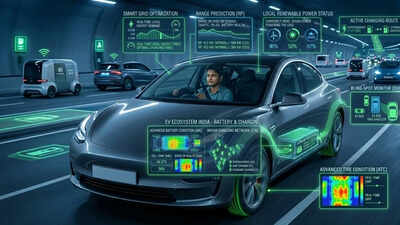
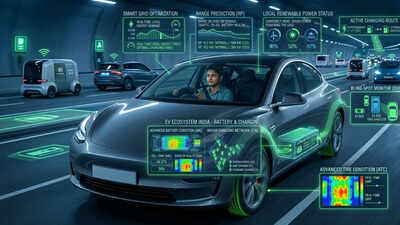
This article is authored by Pratik Kamdar, Co-founder and CEO, Neuron Energy.Over 1.5 million electric vehicles (EVs) are now on India’s roads, reflecting the country’s accelerating transition towards cleaner and more sustainable mobility. This rapid adoption aligns closely with India’s commitment to achieving net-zero emissions by 2070 and reducing dependence on fossil fuels. However, while much of the attention remains focused on EV manufacturers and charging infrastructure, the real enabler behind this transformation is energy storage. As India moves from early adoption to large-scale electrification, the ability to store, manage, and distribute energy efficiently will determine how sustainably and reliably the EV ecosystem can grow. Energy storage is quietly becoming the backbone of India’s EV expansion.
Energy Storage: The Pillar Supporting India’s EV Growth
Battery-driven energy storage systems are increasingly becoming essential to the growth and stability of India’s electric vehicle ecosystem. While vehicle batteries power electric mobility, energy storage systems extend far beyond the vehicle itself. They support charging infrastructure, help stabilise the grid, and enable renewable energy integration, making them central to building a scalable EV ecosystem.One of the biggest challenges in scaling India’s EV market is developing reliable charging infrastructure, especially in rural and remote regions where grid access remains inconsistent. This is where energy storage is making a measurable impact. Fast-charging stations supported by large-scale storage systems are emerging across India, allowing charging infrastructure to function more efficiently while reducing dependence on unstable power supply. These systems improve charging reliability and ensure greater accessibility for EV users.This becomes even more important as EV adoption increases across segments. The success of India’s EV transition depends not only on vehicle availability, but also on whether supporting infrastructure can handle rising electricity demand without placing additional pressure on the grid. Energy storage helps balance peak demand, improve charging efficiency, and strengthen overall grid reliability. Without robust storage systems, charging infrastructure could struggle to keep pace with future EV growth.Energy storage also plays a key role in supporting renewable energy integration. India aims to generate 50% of its energy from renewable sources by 2030, but renewable energy sources like solar and wind are inherently intermittent. Energy storage helps bridge this gap by storing excess renewable energy during periods of low demand and supplying it back during peak consumption. This ensures a more stable and continuous power supply while reducing dependence on fossil fuels.
Overcoming Challenges with Energy Storage Solutions
Despite its potential, several challenges must still be addressed to fully integrate energy storage into India’s EV ecosystem. One of the most pressing issues is the unreliability of the power grid in several parts of the country, particularly in rural areas where frequent outages continue to disrupt infrastructure development. For EV adoption to scale effectively, India must continue investing in grid modernisation and energy resilience.Cost remains another significant barrier. Although battery and storage technology costs have steadily declined globally, affordability continues to be a challenge for manufacturers, infrastructure developers, and consumers in India. Government initiatives such as the Performance-Linked Incentive (PLI) Scheme are playing an important role in encouraging domestic manufacturing and reducing long-term dependence on imports. Continued policy support will be essential in accelerating adoption and making storage technologies more accessible.At the same time, the industry is witnessing the emergence of domestic energy storage companies focused on developing battery systems tailored for Indian operating conditions. With greater emphasis on local manufacturing, battery innovation, and supply chain resilience, the sector is gradually building a stronger foundation to support long-term EV growth.Another important requirement is the development of a skilled workforce capable of designing, implementing, and maintaining energy storage systems. As the sector expands, India will need specialised expertise across battery technology, system integration, and infrastructure management to sustain long-term growth.India’s commitment to green energy must therefore be matched by strategic investments in energy storage infrastructure, domestic manufacturing, and workforce development. Only through this balanced approach can the country build an EV ecosystem that is both scalable and resilient.
Conclusion: The Future of EVs Depends on Energy Storage
As India continues to expand its electric vehicle market, energy storage will play an increasingly central role in shaping the country’s clean mobility future. While EVs and charging infrastructure remain the visible components of this transition, energy storage is the critical enabler that supports charging reliability, grid stability, and renewable energy integration.With continued investment, innovation, and supportive government policies, India has the potential to emerge as a global leader in both EV manufacturing and energy storage. The future of India’s electric mobility ecosystem will depend not only on vehicle adoption but also on the country’s ability to build a strong and reliable energy infrastructure around it. In this transition, energy storage will remain one of the most strategic enablers of India’s next phase of EV growth.Disclaimer: Views and opinions expressed in this article are solely those of the original author and do not represent any of The Times Group or its employees.