




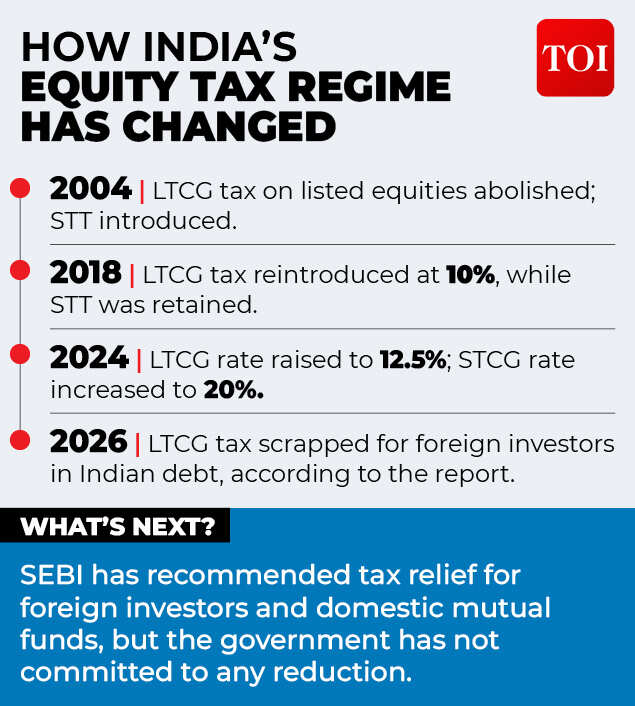
India’s long-term capital gains (LTCG) tax has now become a pressing pain for investors and the ongoing flight of foreign investors is being closely linked to the country’s somewhat unique regime of taxing stock market gains.India stands out internationally for its move to tax capital gains in the same country where the profits have been made. Reports suggest that globally most major stock markets do not have such a tax or the gains are taxed in an investor’s home country.Major stock markets around the world such as the US, Singapore, Hong Kong, Saudi Arabia, UK, UAE do not have any such tax, according to a Reuters report.India’s stock market has not hit a new closing high in over two years now. But India’s LTCG is not a new thing. It was introduced back in 2018, and has since then evolved. So why is the ongoing exodus of foreign investors since last year being linked to LTCG tax?
What is LTCG and how does it work?
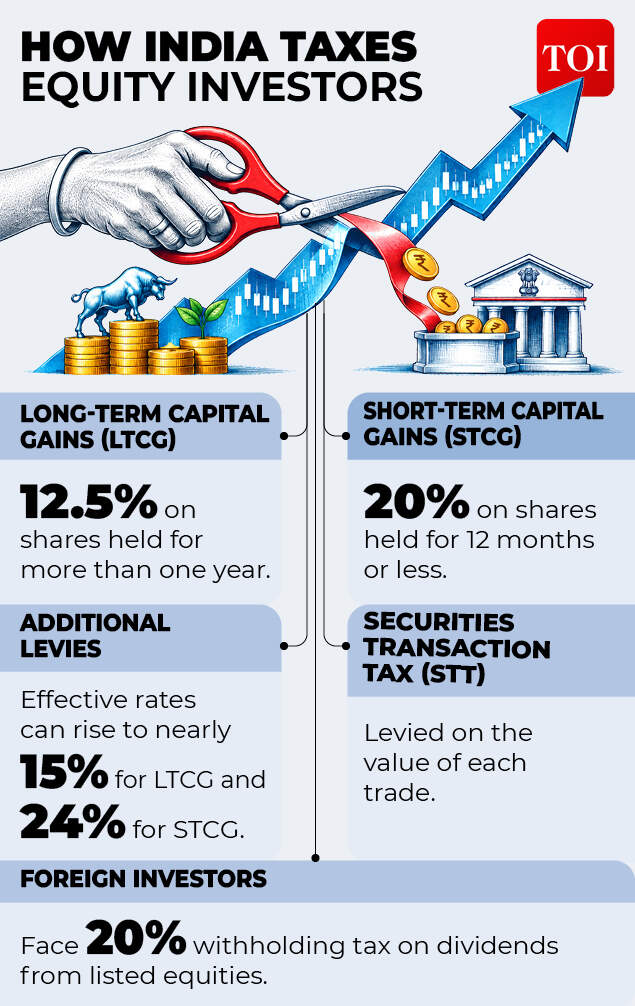
In India, both domestic and foreign investors face the same tax rates and structure.The taxes for equity market investments are divided on the basis of what the government defines as short-term and long-term periods of investment.

How India taxes equity investors
For shares that you hold for a period of more than 12 months, a long-term capital gains (LTCG) tax rate of 12.5% is applicable. An annual exemption of Rs 1.25 lakh applies cumulatively across listed shares and equity mutual funds.For shares held for less than a year the applicable short-term capital gains (STCG) is 20%.Apart from this sometimes levies like health and education cess, can increase the effective rate to 15% and 24% respectively.Additionally, investors face a Securities Transaction Tax (Set) that is levied on the value of each trade. This varies for cash equities and equity derivatives.
The case for removing LTCG
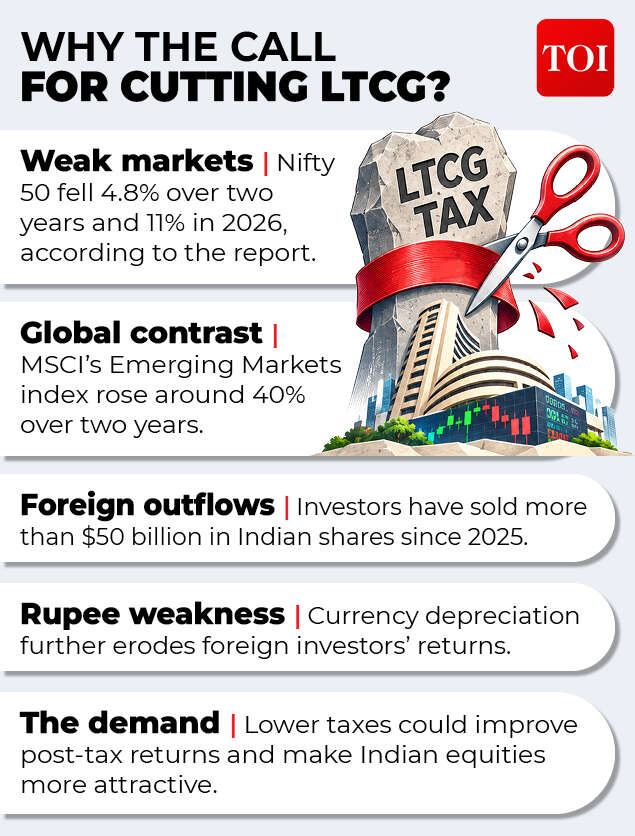
Indian equity benchmarks, Nifty50 and BSE Sensex are in deep red this year, In fact, they are set for their worst annual stress in over a decade. However, in the last two years MSCI’s Emerging Markets Index has actually seen a jump of 40%.So clearly India is out of favour with foreign investors who are selling here and buying elsewhere. The rationale for growing demands of LTCG removal stem from a need to make India’s post-tax returns more lucrative to retain investors’ interest.

Why the call for cutting LTCG tax?
The noise around removing LTCG, especially for foreign investors, is growing. Recently, SEBI urged the government to remove LTCG for foreign investors. SBI too in its report has said that while the RBI has been taking all possible steps to thwart a seemingly difficult global playbook, there is an urgent need also by the government to address some of the long pending structural issues regarding capital inflows.“The government must seriously look into anchoring hot money flows into the equity segment by extending the holding period to say 2-3 years and abolishing the long term capital gains tax for equity,” SBI said in a recent research report.Experts believe that removing the LTCG tax could send a strong signal that India wants to remain competitive for global capital. Also, with slower and fewer outflows of capital, and possibly greater inflows, the rupee will likely stabilise.


What FM Sithraman has said
The government too seems to be receptive to this growing clamour. Finance minister Nirmala Sitharaman has said that voices are being heard. Her statements on the issue have led to the stock market rallying in anticipation of some announcement.On Monday, she said that the government would consider the request on structure of taxes on capital gains on equities.“The circumstances have changed and, therefore, the voices of concern are louder,’’ she said. “I quite appreciate that. So, I’ll consider all this… Our growth is very important, where people are putting their very best, we are able to see sustained 7(%)-plus growth,” she added.
Will reducing or removing LTCG make Indian stock markets more attractive?
Foreign Portfolio Investors (FPIs) took out $19 billion in 2025 and about $30 billion is 2026 so far this year. A significant part of this money was used by FPIs to invest in the AI trade.Experts believe that removing LTCG would improve India’s relative tax competitiveness, particularly for foreign portfolio investors, as India currently imposes capital gains tax on listed equity investments while several competing Asian markets offer more favourable treatment to foreign investors.“Removing LTCG would reduce the post-tax return disadvantage and make India more attractive to global fund managers comparing investment destinations,” says Thomas Stephen, Director & Head – Preferred, Anand Rathi Shares and Stock Brokers.However, experts believe that taxation is only one component of investment decisions.For example, China offers relatively attractive valuations and exposure to technology, while Taiwan and South Korea benefit from strong semiconductor and artificial intelligence-related investment opportunities.“India, meanwhile, continues to offer exposure to domestic consumption, financialization, infrastructure and long-term economic growth. Therefore, removing LTCG could narrow the tax disadvantage but would not automatically redirect foreign capital from these markets into India,” Thomas Stephen tells TOI.According to Riaz Thingna, Partner, Grant Thornton Bharat, removing LTCG can help in multiple ways:
- Abolition or rationalisation of LTCG could provide a meaningful sentiment boost by improving post-tax equity returns.
- For foreign investors, it could make it more attractive to allocate additional capital to India.
- For domestic investors, it could strengthen the attractiveness of long-term equity ownership.
So, it’s clear that it would certainly improve India’s relative tax competitiveness.

How India’s equity tax regime has changed
But, as Riaz Thingna points out: Global investors compare markets on a much wider set of parameters.“Removing LTCG would eliminate one disadvantage in India’s post-tax return proposition and bring India closer to markets where foreign portfolio capital can receive more favourable capital-gains treatment,” he tells TOI.
Why removing LTCG will help, but not solve the problem
The government collected approximately Rs 1.29 lakh crore in equity LTCG tax in FY25, compared with Rs 72,249 crore in the previous assessment year. STT collections were estimated at approximately Rs 32,000 crore in FY24, with a substantial portion coming from derivatives rather than long-term equity investments.But, these collection figures should not be interpreted as capital inflows lost.“The actual impact is through lower post-tax returns, higher transaction costs and potentially lower investor participation,” Thomas Stephen says.Several factors have been contributing to the outflows – it’s actually what many would call a perfect storm.Valuations in the stock market were seen to be high, then the regime change and resulting tariff related uncertainty in the US added to woes, the rupee has been depreciating (a cycle aggravated by foreign investors outflows!), the US-Iran war has resulted in crude oil prices crossing $120 per barrel, India does not have an AI-led story to show while other EMs and major stock markets have offered attractive returns.So, LTCG adds to the woes, but by itself is not the single-largest factor driving the flight. In fact, despite the Budget changes in LTCG announced in 2024, stock markets continued to hit fresh highs.Hence, removing it would help improve competitiveness, but all other factors could still be in place. After all, India continues to be the fastest growing major economy in the world with a strong domestic story. But that has not been enough to make investors flock to its stock market in the last two years.Thomas Stephen of Anand Rathi explains: Removing LTCG tax could improve sentiment and encourage foreign investors to reconsider their India allocations, but it is unlikely to independently entirely reverse the FPI selling trend.“The recent outflows have been driven by a combination of relatively expensive valuations, concerns over corporate earnings growth, rupee depreciation, elevated crude oil prices and more attractive opportunities in competing markets. However, tax reform can act as a positive catalyst, but a sustained reversal in FPI flows would require more attractive valuations, improving earnings growth and greater currency stability,” he says.In fact, Riaz Thingna says that while removing LTCG could be a positive step, it would not be a silver bullet for FPI outflows.“The immediate impact could, therefore, be positive, but the durability and scale of incremental flows would ultimately depend on earnings, valuations and the broader macroeconomic environment. The government may need to weigh any revenue loss against the potential benefits of higher foreign investment,” Riaz Thingna tells TOI.VK Vijayakumar sums it up: Scrapping of LTCG tax alone will not make India attractive. Ultimately investment will be determined by earnings growth.“India will have to deliver on earnings growth. Fortunately, after tepid earnings during FY25 and FY26, earnings growth is improving this year. Nifty 50 earnings growth of 15% is achievable in FY27,” he tells TOI.Finally, valuations, corporate earnings, the rupee, and global interest rates are likely to remain more important in determining the direction and sustainability of FPI flows. Tax rationalisation could certainly improve India’s relative attractiveness, but it may not substitute for earnings growth and attractive entry valuations.(Disclaimer: Recommendations and views on the stock market, or any other asset classes or personal finance management tips given by experts and analysts are their own. These opinions do not represent the views of The Times of India.)