


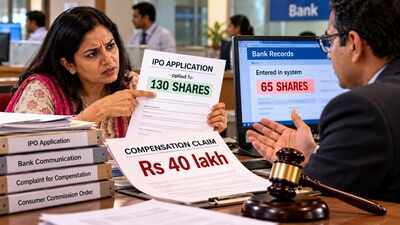
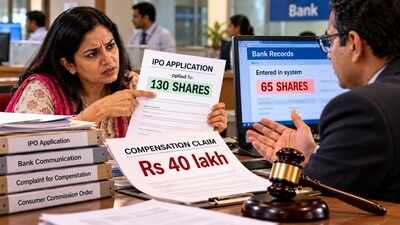
You apply for a certain number of shares for an Initial Public Offering (IPO) and then discover that the bank has recorded only half of the number! What do you do in such a case where there is a cut in the potential size of your allotment?This is what a woman, an Ahmedabad resident, faced. She claimed the bank’s mistake caused her a loss of Rs 42,142 and sought a compensation of Rs 40 lakh.
What the case is about
In 2022, the woman applied for 130 shares in an IPO. However, the bank recorded her application for just 65 shares, which she claimed resulted in a loss of Rs 42,142. She also accused the bank of causing her physical and mental harassment.Also Read | Rs 5.89 crore FD interest slashed from 7.75% to 3.5% without notice; Delhi High Court rejects bank’s non-renewal argument and orders interest at an average of earlier ratesThe woman initially took her complaint to the Ahmedabad District Consumer Commission, but her appeal was dismissed. She subsequently approached the Gujarat State Consumer Disputes Redressal Commission. The state commission heard the matter and ruled in her favour, though it granted her only partial relief.The woman claimed that the discrepancy resulted from an error by the bank, which, according to her, acknowledged the mistake in an official communication.Representing his wife, her husband argued that the bank could not escape responsibility by dismissing the mistake as “typographical” or “clerical”. He also submitted that her account had sufficient funds to cover the IPO application. Had the bank entered the correct number of shares, he argued, she would have been allotted 130 shares.“A data-entry or clerical error committed by a bank employee, if it results in financial loss to the customer or deprives the customer of a financial benefit, cannot be treated as an ordinary or significant mistake,” her counsel argued according to an ET report, citing ICICI Bank vs Santosh Sardana (2021).The bank’s counsel argued that the transaction was intended to facilitate an investment in shares with the objective of earning a profit. On that basis, the lawyer maintained that it was a commercial activity and the woman did not meet the definition of a ‘consumer’.“Share trading is a commercial activity and an investor is not a “consumer” within the meaning of the Consumer Protection Act”, the bank’s counsel said.Also Read | She worked as a teacher till 62 years of age instead of retiring at 60, but was denied gratuity because of extended service; Allahabad HC orders payment with 6% interestThe bank’s lawyer also contended that the Ahmedabad District Consumer Commission was right to conclude that the woman had not furnished proof of payment of consideration to the bank. According to the counsel, she had also failed to provide documentary evidence showing that she was entitled to an allotment of 130 shares and had lost that entitlement because of the bank’s alleged mistake.The District Commission rejected her complaint on the ground that she did not qualify as a consumer. It held that investing in shares amounted to a commercial activity and, consequently, the complaint was not maintainable, Supriya Majumdar, Partner at Elarra Law Offices, told ET.The Gujarat State Consumer Disputes Redressal Commission subsequently partly allowed the woman’s appeal.Also Read | Sisters sought share in parents’ properties under Hindu Succession law; Madras HC rules for brother over mother’s land on ouster, father’s estate over missing parties
Why did the State Consumer Disputes Redressal Commission provide some relief?
After considering the arguments from both sides, the Gujarat State Consumer Disputes Redressal Commission held that the woman could be considered a beneficiary of the bank’s services. It said that the fact that she had not directly paid the bank did not, by itself, conclusively establish that she was not a consumer.The commission also observed that a transaction involving shares does not automatically make every dispute concerning banking services associated with an IPO a commercial dispute. Therefore, the woman could not be denied the right to seek redressal against the bank merely because her complaint arose from an IPO application.“Banking institutions are required to maintain a reasonable degree of care, accuracy, and diligence when processing applications and entering customer-related information,” the commission stated according to the ET report.However, the commission did not agree with the woman’s claim that she had suffered a loss of Rs 42,142. It also rejected her demand for Rs 40 lakh in compensation, describing the amount as “highly excessive”.Instead, the commission directed the bank to pay her:
- Rs 20,000 for deficiency in service.
- Rs 10,000 for mental agony and harassment.
- Rs 7,000 towards the costs of the original proceedings and the present appeal.
The total amount payable to the woman was therefore Rs 37,000.Supriya Majumdar said the woman succeeded in her appeal on two counts: the maintainability of her complaint and the deficiency in the services provided by the bank.During the appeal, the complainant also submitted a SEBI circular to argue that banks providing IPO-related services were entitled to receive charges or compensation from another institution or entity.“Thus, although the complainant may not have personally paid any consideration to the bank, the circular indicated that the IPO-related service was not necessarily a service rendered entirely without consideration, as the bank was entitled to receive compensation,” she explained.Also Read | 83-year-old woman got Rs 12.28 lakh after son’s death, but sought Rs 15,000 maintenance from college-going granddaughter and a share of family pension from son’s widow; Kerala HC rejects both claimsThe commission rejected the claimed financial loss because allotment in an IPO is governed by prescribed procedures and subscription ratios. Consequently, assuming that the woman would certainly have received all 130 shares was speculative.Majumdar emphasised that, although the bank had admitted entering an incorrect number of shares in the application, the woman had not established that the error caused her a loss of Rs 42,142.Her claim depended on the “assumption” that she would necessarily have been allotted 130 shares had the application been recorded correctly, rather than on concrete evidence demonstrating that outcome.For this reason, the commission declined to award the Rs 40 lakh compensation she had sought.Also Read | Man paid Rs 1.73 crore for Gurgaon flat, waited over a decade without possession; builder alleges homebuyer bought it for commercial gain, consumer commission awards refund with 12% interest & Rs 4 lakh