

‘Let the oil flow’: What Trump’s possible peace deal with Iran, Strait of Hormuz opening mean for India
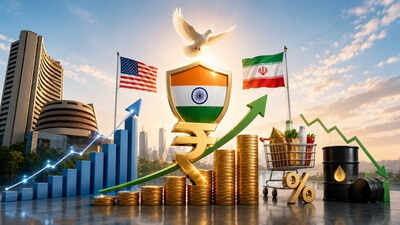
“Ships of the World, start your engines,” US President Donald Trump wrote on Truth Social, announcing an imminent peace deal with Iran and the opening of the Strait of Hormuz. “Let the oil flow!” he said. The peace deal is reportedly going to be signed on Friday in Geneva.The Strait of Hormuz closure has been responsible for global crude oil prices surging and resulting in an economic shock for the world. India, dependent on imports for almost 90% of its needs, has seen the impact.Rupee has depreciated sharply, petrol and diesel prices have risen, inflation is climbing, forex reserves have fallen, oil import bill has gone up, foreign investors have rushed out, stock markets have fallen, and GDP growth forecasts have been trimmed. But that could change if a peace deal materialises, though that remains a big if, given how many times an agreement has appeared close only to fall through. If it does happen, it would reduce the impact of the US-Iran war on the Indian economy and its key fundamentals to a few quarters.Let’s take a look at what a possible US-Iran peace deal signing and Strait of Hormuz opening mean for crude oil prices, rupee, stock market, inflation, balance of payments, and GDP growth:
Crude oil, petrol, diesel & LPG prices
Crude oil prices have already shown how temporary the nature of their rise is – if the Strait of Hormuz opens, global supply will likely be restored in the coming months, bringing down prices. From peaks of around $120 per barrel seen during the conflict, crude prices have dropped below $85 per barrel in hopes of a peace deal. Aș per SBI Research estimates, every $10 per bbl increase in crude oil prices may widen the CAD by 36 bps in FY27. Falling crude oil prices would help check a widening current account deficit. A recent Fitch report sees the oil market returning to over supply once the crisis is resolved. “The disruption does not alter the longer-term direction of the market, which is expected to return to surplus conditions later this year,” Fitch Ratings said. The rating agency sees crude oil prices on an average being at around $87 per barrel in 2026.So what does this mean for India? Petrol and diesel prices have seen a Rs 7.5-8 per litre hike since May 15, 2026. Before that the government had cut excise duties on the two fuels to keep prices in check. Oil marketing companies are still suffering huge losses in everyday retail sales. LPG prices for domestic cylinders have also been increased twice since the conflict began.But, even as supplies ease and global prices come down, it may take some time for retail prices of petrol, diesel, and LPG to come down meaningfully.
Rupee
Perhaps one of the biggest beneficiaries would be the rupee, which has been on a record depreciation spree – dropping to almost 97 versus the US dollar recently. Already weakened in 2025 due to foreign outflows, the Middle East issue has been a big blow for the Indian currency. The Reserve Bank of India (RBI’s) recent steps to attract foreign inflows, and the government move on tax exemption for bonds, have helped stabilise the currency.Jateen Trivedi, VP Research Analyst – Commodity and Currency, LKP Securities says that if the US-Iran peace deal is formally signed and the Strait of Hormuz returns to normal pre-war traffic conditions, it would be a significant positive for the rupee. “The biggest benefit would come through smoother crude oil supplies, reduced freight and insurance costs, and lower concerns over India’s import bill. Since India imports a large portion of its energy requirements, normalization of crude flows can improve sentiment towards the rupee and reduce pressure on the current account deficit,” Trivedi tells TOI.The rupee has already started showing signs of recovery over the past few sessions as markets anticipate a potential resolution. “A stable energy market environment would further support the currency and could encourage foreign investors to reassess emerging market allocations. However, the key factor from here will be FII flows. Even if crude-related pressures ease, persistent FII outflows could still limit rupee gains and remain a concern for overall currency stability,” he cautions.“Technically, the rupee has important support near the 95.00 zone. As long as it holds above 95.25, the recovery trend remains intact and a move towards 94.00 cannot be ruled out in the coming weeks if geopolitical conditions continue to improve and capital flows stabilize,” he added.
Balance of Payments
Chief Economic Advisor V. Anantha Nageswaran recently called the ongoing situation a live balance of payments ‘stress test’ for India. With higher crude import bills, continued foreign investor outflows, and weakening rupee, India has been looking to keep its balance of payments deficit under check.
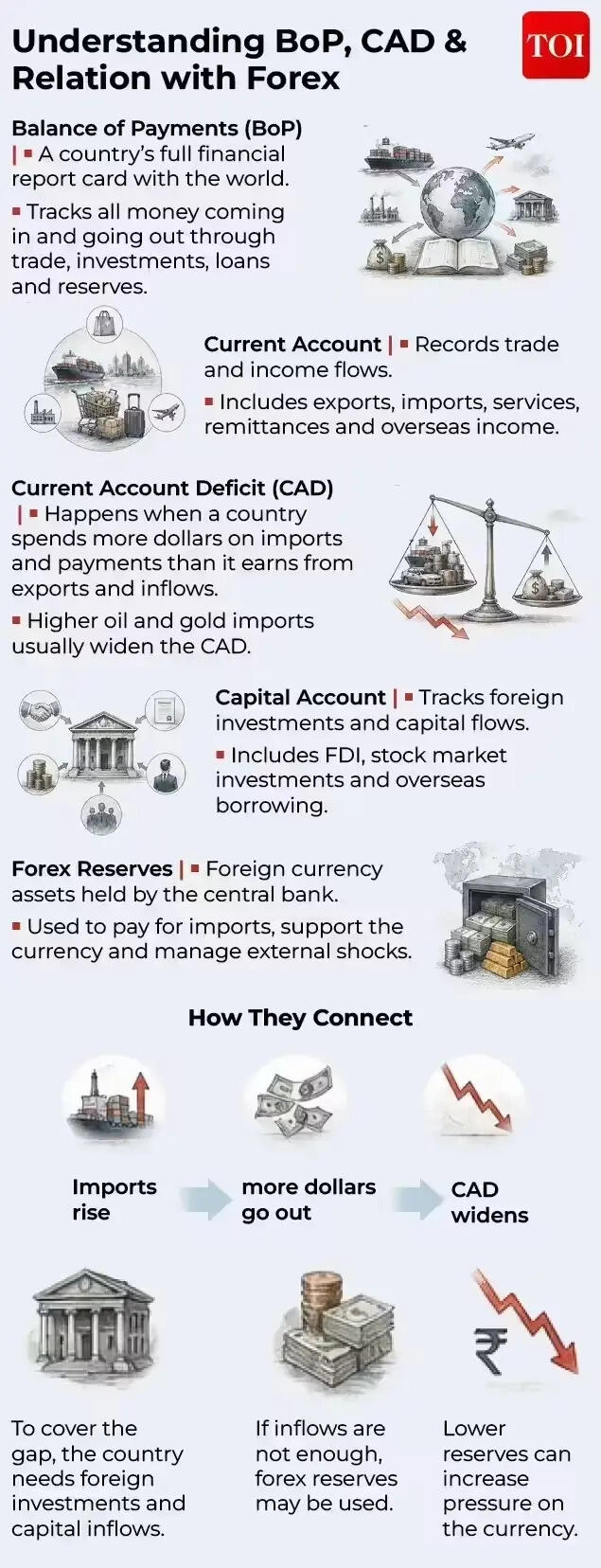
Once rupee appreciates, foreign investors come back to the market, and oil bill reduces, the forex will be less under pressure and current account deficit and balance of payments will get a breather to recover.
Stock market & FIIs
The immediate impact of the US-Iran war on the stock markets was brutal. In March itself, investors lost as much as Rs 51 lakh crore due to the conflict. Since then the markets have been volatile, recovering in between in hopes of a resolution to the conflict. Sensex is down over 6% since the start of March, having recovered recently. Foreign Institutional Investors (FIIs) have been selling relentlessly. Asked about what the peace deal would mean for foreign fund inflows, VK Vijayakumar, Chief Investment Strategist, Geojit Investments Limited told TOI, “One of the factors that triggered big FII selling recently has been the continuous weakness in the rupee. With the initiatives by the government and RBI to attract more capital into India, the rupee has stabilised. Now with Brent crude crashing to around $84 from the peak of $119.5, India’s current account deficit will decline. This augurs well for the rupee. With rupee stabilising and even appreciating, FII selling will taper off. Rupee can eventually appreciate to 93 to the dollar. This is positive for FII flows and the stock market.”“Investors can be optimistic but not euphoric. It will take some time for FIIs to turn buyers in India. Also, the expected poor monsoon is a concern,” he cautioned.
Inflation
The impact of the US-Iran conflict is finally being felt with the wholesale price inflation touching almost double digits in May, rising steadily since the start of the war. Consumer Price Index (CPI) data – which is tracked and targeted by the RBI – reflects a more moderate increase, and is still below the central bank’s target of 4%.As crude oil prices come down, and input costs of various materials reduce, inflation will likely moderate, making the fiscal and monetary math easier for the government. However, the prospect of El Nino and its impact on monsoon and subsequently food prices, may add pressure to inflation.
GDP growth
India continues to be the world’s fastest growing major economy, and the IMF has even marginally raised its growth forecasts for the current year. However, recently several economists and experts have flagged the impact of the US-Iran war over the next few quarters for India’s GDP. RBI too has cut its growth prediction for FY 2026-27 to 6.6% in June from 6.9% projected in April.If the Middle East conflict sees a long-lasting solution in the coming days, the negative impact so far on the Indian economy will likely be transient.
The road ahead
The global economic outlook continues to be fragile. India’s domestic story is strong, but faces external headwinds. Any meaningful relief from the ongoing situation will come only if the US and Iran are able to end the conflict and trade flows via Strait of Hormuz can restart without any disruptions.Rajnish Gupta, Partner, Tax and Economic Policy Group, EY India says, “An easing of geopolitical tensions, combined with the reopening of key trade routes, should help correct global oil prices, ease fuel-driven inflation, reduce pressure on the fiscal deficit, and provide support to the rupee. Beyond energy, the removal of supply chain disruptions will also give a meaningful fillip to manufacturing activity and export recovery to the West Asian region.”“At the same time, we are mindful that a series of steps still need to fall into place — normalization of trade routes, stabilization of global supply chains, and sustained diplomatic momentum for these gains to fully materialize,” he concludes.