

Retired PSU bank employee claimed Rs 9.29 lakh leave encashment as tax-free, but taxman restricted exemption to Rs 3 lakh; ITAT applies Rs 25 lakh limit retrospectively, cancels Rs 6.29 lakh addition
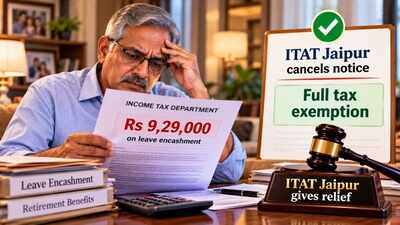
Leave encashment is tax-free up to a limit for non-government employees. While the limit was earlier Rs 3 lakh, it was revised to Rs 25 lakh in 2023. There is no such upper limit for government employees. What happens if you don’t know the limit and do not pay tax on your leave encashment.In one such case a retired employee of State Bank of India (SBI) got leave encashment but did not pay tax.
What the case is about
Under income tax law, SBI staff are treated as non-government employees and, therefore, can claim leave encashment exemption subject to the applicable limit.A retired SBI employee from Jaipur, was unaware of this distinction. When he retired in 2020 he received Rs 9.29 lakh as leave encashment and did not pay tax on the amount.Also Read | Man sold his house and bought a Rs 1.10 crore flat jointly with wife; income tax department denies Rs 55.48 lakh capital gains exemption for half the amount, but ITAT Mumbai gives full reliefAt that time, the exemption limit was Rs 3 lakh. It was subsequently increased to Rs 25 lakh in 2023 through Notification No. S.O. 2276(E).Under the limit applicable when the man retired, he would technically have been liable to pay tax on Rs 6.29 lakh, the amount that exceeded the Rs 3 lakh exemption.The man filed his income tax return (ITR) declaring total income of Rs 6.76 lakh from pension and other sources. In the return, he claimed an exemption of the entire Rs 9.29 lakh received as leave encashment under Section 10(10AA), which covers the cash equivalent of leave salary received at retirement.When the Income Tax Assessing Officer (AO) processed his return, the claim was restricted to Rs 3 lakh. The officer added the remaining Rs 6.29 lakh to Gupta’s taxable income, taking his total income to Rs 13.05 lakh, according to an ET report on the judgement.The Commissioner of Income Tax (Appeals), or CIT(A), upheld the adjustment, relying on the Delhi High Court’s judgment in Kamal Kumar Kalia v. Union of India [2020] 268 Taxman 398 (Delhi).The man however appealed before the Income Tax Appellate Tribunal (ITAT), Jaipur.On September 22, 2026, the ITAT Jaipur ruled in the retired bank employee’s favour.Also Read | She bought shares for Rs 13.5 lakh and sold them for Rs 77.47 lakh after 18 months; taxman denied capital gains exemption, but ITAT gives relief and deletes Rs 79 lakh in additions
Why did the retired bank employee get tax relief from ITAT?
The Jaipur tax tribunal noted that the distinction between government employees and other employees under clause (10AA) of Section 10 had been upheld by the Delhi High Court in Kamal Kumar Kalia (supra). The High Court had ruled that employees of public sector undertakings and nationalised banks could not claim the same status as government employees for this purpose.The ITAT Jaipur observed that the revised leave encashment exemption limit of Rs 25 lakh took effect from April 1, 2023, following the notification issued on May 24, 2023.According to the tribunal, the 2023 revision did not amount to the introduction of a new exemption. Instead, it was the belated fulfilment of an obligation, as the exemption ceiling had remained at Rs 3 lakh since 2002 despite successive revisions to salaries.ITAT Jaipur observed: “A notification of that character is remedial, and to withhold its benefit from an employee who retired shortly before it was issued would perpetuate the very disparity it was meant to remove.”Also Read | Rs 5.89 crore FD interest slashed from 7.75% to 3.5% without notice; Delhi High Court rejects bank’s non-renewal argument and orders interest at an average of earlier ratesThe tribunal also noted that its Coordinate Benches had consistently adopted the same approach in cases involving retired bank employees. These included Dashrath Kumar Sen v. ACIT [2025] 172 taxmann.com 772 (Jaipur – Trib.), which dealt with the same assessment year, AY 2020-21, and Govind Chhatwani v. CIT (Appeals) [2026] 187 taxmann.com 389 (Jaipur – Trib.).The tribunal said: “The amount of Rs 9,29,033 received by him is well within the limit of Rs 25,00,000, and no other limit prescribed by the sub-clause has been applied against him.”Accordingly, the ITAT directed the Assessing Officer (AO) to allow the full exemption of Rs 9,29,033 under Section 10(10AA) and delete the addition of Rs 6,29,033.Also Read | Grandmother and her son gifted 2.5-acre land to his second wife, who sold it; his daughter from first marriage claimed it was ancestral, but Madras HC rejects her pleaChartered Accountant Suresh Surana told ET that the Jaipur Bench of the Income Tax Appellate Tribunal (ITAT) extended the enhanced Rs 25 lakh exemption limit for leave encashment to a retired State Bank of India employee, even though his case concerned assessment year 2020-21, before the statutory limit was raised in 2023.Surana points out that the tribunal did not classify SBI employees as equivalent to Central or State Government employees. It made clear that staff working for public-sector undertakings and nationalised banks are not eligible for the unlimited leave encashment tax exemption available to government employees.The ITAT Jaipur held that denying the revised benefit to someone who had retired shortly before the higher limit was notified would continue the very disparity that the change was intended to address.