
Rohit Sharma playbook Suryakumar Yadav keeps in his pocket: T20 World Cup 2026 | Cricket News
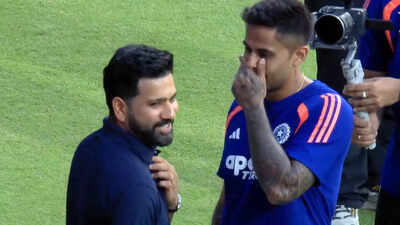
In the run-up to this T20 World Cup, Suryakumar Yadav was asked about the all-attack approach he had instilled in the T20 team. India were on an impressive winning run and the question perhaps begged itself. But the captain immediately contradicted the journalist.Go Beyond The Boundary with our YouTube channel. SUBSCRIBE NOW!“It’s true that we are playing that form of cricket, but it’s not me who started it,” he said. “We started playing this brand of cricket under Rohit,” Surya said, explaining how deeply indebted the team was to its former captain, under whom Surya has played both for India and Mumbai Indians.
It is the mindset change that Rohit, working in tandem with then coach Rahul Dravid, first brought to this team that has made them such a powerhouse in T20 cricket today. We need to go back and understand how the change happened.India, after a brilliant initiation to the T20 format with the inaugural World Cup win under MS Dhoni in 2007, had slowly settled into a style that was getting outdated. Though the team was always competitive through the 2010s, the fact that Dhoni — and later Virat Kohli’s team — didn’t win a World Cup indicated something was going wrong.ALSO READ: Firm ideas, flexible tactics: How Gautam Gambhir helped India tame T20’s fickle natureThe point of inflection probably came in the 2022 World Cup in Australia when India lost by 10 wickets to England in the semifinal in Adelaide. Rohit-led India had put up 168 on that day, a target which England galloped to in 16 overs.After that harsh defeat, Rohit understood that something had to change. That’s when he decided to bring in a complete change of approach to T20 cricket. It started with the opening partnership itself and Rohit took it upon himself to launch an attack right from the beginning. Up until then, 50 runs were more than acceptable in the Powerplay.Taking a cue from teams like Australia and England, Rohit figured that the envelope needed to be pushed and 75 was something that India should target in the first six overs. It didn’t matter to him if a couple of wickets fell in the process. The idea was to take the battle to the opposition right from the word go.Rohit showed the world how it could be done during the 2024 World Cup in St Lucia, when his 41-ball 92 didn’t just help India thrash Australia but sent them home from the Super Six stage.To have that no-fear approach, there was a sacrifice that Rohit had to make. No could no longer go in with four specialist bowlers. It had to be three and they were backed up by three (or four) allrounders. In 2024, it was Ravindra Jadeja, Axar Patel, Shivam Dube and Hardik Pandya who were backing up Jasprit Bumrah, Arshdeep Singh and Kuldeep Yadav, the three bowlers.This meant that while batters could bat with a sense of freedom secure in the knowledge that there is cover till No. 8, the specialist bowlers had to take more responsibility.It, of course, helped that India found Jasprit Bumrah at the peak of his powers. The unconventional pacer, who hardly goes for more than 25 in his four overs, invariably gave India the extra cushion to work with. Post 2024, as Rohit, Virat Kohli and Jadeja retired and Surya took over, he started taking this philosophy to the next level.Of course, it helped that he got a coach in Gautam Gambhir who too believes in a similar philosophy. Surya decided that Abhishek Sharma was his No. 1 opener. It was after an IPL game where he was the Man of the Match that Abhishek said, “Surya-bhai keeps telling me to go on playing like this. He follows my game closely, which gives me a lot of confidence.”While Abhishek was up and down in this World Cup, India’s lineup — with eight batters — never took a backward step. Sanju Samson, who found his spot in the XI in the latter stages, came in with the same mindset. Even though Samson had failed in a number of games before he got his chance against Zimbabwe in Chennai, the team management ensured that he didn’t change his batting style.It was this fearlessness flowing down the order that helped India get scores of 256-4 and 253-7 in the two must-win games against Zimbabwe and England and chase down 199 against the West Indies.The approach had its costs, putting extreme pressure on the allrounders, especially with mystery spinner C Varun losing his rhythm. But Surya, just like Rohit before him, knew that with Jasprit Bumrah in his arsenal, he could afford that risk. The fact was that Hardik found his mojo, Arshdeep was dependable and Axar delivered just when it mattered. All of it mattered in the end.With the defeat to South Africa, there were questions whether the philosophy was faulty. But Surya was adamant and stuck with an idea that he had seen working, both as a player and captain. The conviction had a lot to do with what he learnt from his predecessor Rohit.“In sports, wins and losses keep happening. Everybody works hard, sometimes, it works and sometimes it doesn’t. I have learnt this from Rohit that in life, being balanced is important. I have never seen his character change, through good or bad times,” Surya pointed out, in an emphatic hat-tip to his master.It is this clarity of thought that did the job for India the last time, and it is the same playbook that they fell back on now, to become undisputed kings of the T20 universe.