

The big Indian IT sector shake-up: GCCs are hiring more than traditional tech; who is getting the jobs?


The Indian IT sector is undergoing a tectonic shift with artificial intelligence rendering many traditional roles redundant and requiring an unprecedented skill upgradation to stay employable. Even as the traditional IT firms continue to hire and fire, one branch of the IT sector is emerging as an employment source that cannot be ignored.Global Capability Centres or GCCs which are essentially specialised offshore units of multinational companies are fast absorbing talent from the traditional IT sector.A recent PwC report on GCCs notes that they have migrated from providing transactional back-office support to shaping enterprise strategy and outcomes spanning advanced analytics, product engineering, cybersecurity, AI research and development, and increasingly, global P&L mandates.Also Read | Indian IT sector job market is changing: What can get you hired & at a premiumThe trend suggests that India’s GCCs are emerging as an increasingly important engine of technology hiring. Demand for talent is accelerating as companies are expanding beyond cost-focused operations into technology, innovation and enterprise transformation.But can GCCs absorb talent across levels that are not finding jobs in traditional IT sector firms? At what skill and salary levels is the hiring happening? We look at the trends:
GCCs outpace traditional IT services hiring
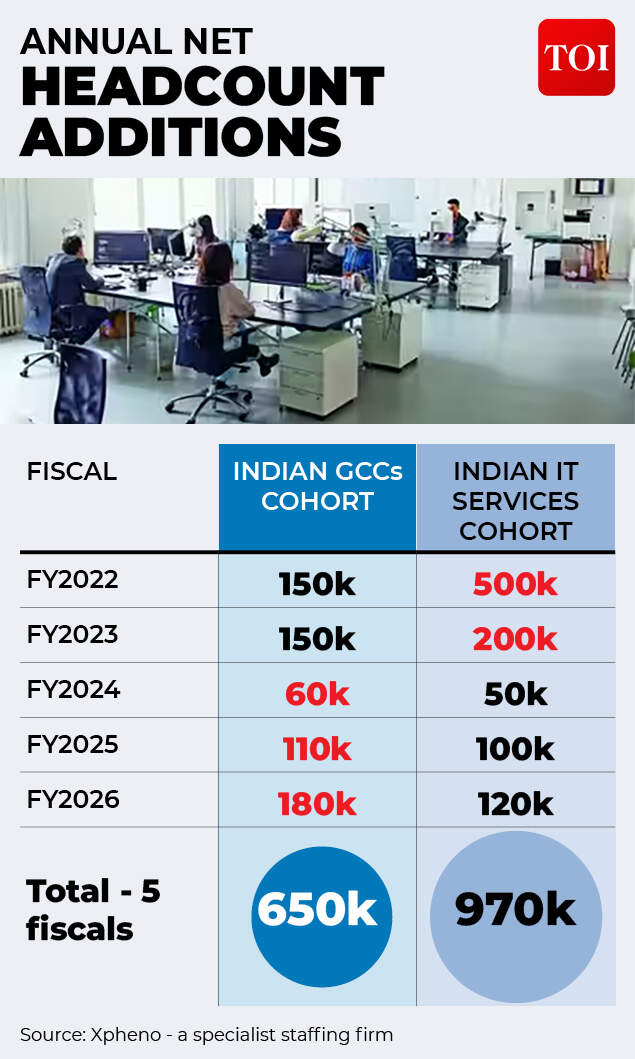
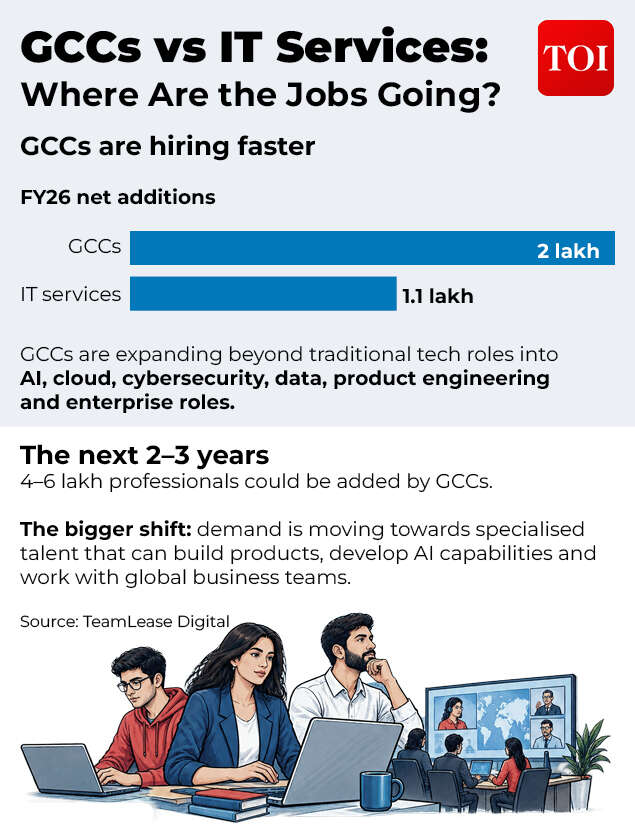
Experts see GCCs as an important engine for new technology jobs.“GCCs are clearly becoming a bigger engine of net new tech jobs than the IT services companies. In FY26, GCCs added around 2,00,000 net employees, compared with roughly 110,000 in IT services,” Neeti Sharma, CEO, TeamLease Digital tells TOI.Data speaks for itself: According to Xpheno, a specialist staffing firm, over the last 3 fiscal years, the Indian GCCs cohort has overtaken the IT services cohort on net annual additions.
Annual Net Headcount Additions
Their overall contribution to the Indian tech sector headcount has marginally moved up from 24% to 25% during the 3-year period.In the current year, the trend of hiring demand from GCCs has been largely stable with no sharp spikes or drops in volume or velocity.“The total active openings, with a 4-week freshness cutoff, in the GCCs cohort is at 17,000 in August after a 1,000 drop from 18,000 in July 2026. The active demand volume in the GCCs cohort has been ranging in the 17,000-18,000 over the last 4 months after the 19,000 mark in March 2026, as the highest active volume for 2026,” Kamal Karanth, co-founder, Xpheno tells TOI.Anuradha Mohanty, Associate Partner, Human Capital Solutions, India, Aon tells TOI, “What we are seeing is that GCCs and traditional IT services firms are responding to the same macro forces, but arriving at very different talent strategies, which is what makes the current market so fascinating.”The clearest signal, in our view, comes from compensation. According to Aon’s latest Salary Increase Survey, projected salary increases for GCCs stand at approximately 9.3% in 2026, compared with 6.6% for technology consulting and services firms.“Compensation is often the most powerful indicator of employer confidence. When one segment is willing to consistently pay above market while another remains more restrained, it reflects where organizations see future value creation and where they are prepared to invest for growth,” she says.
At what levels is hiring happening and at what salaries?
Experts note that demand for artificial intelligence-linked talent is picking up. According to the recent PwC report, the demand is strongest for talent that can develop AI models, engineer the data foundations behind them, govern their risks, secure their deployment, and convert them into products and platforms that deliver measurable enterprise outcomes.Neeti Sharma of Teamlease Digital sees the strongest demand for AI and GenAI, cloud, cybersecurity, data, automation, product engineering and AI deployment.
GCCs vs IT services: Where are the jobs going?
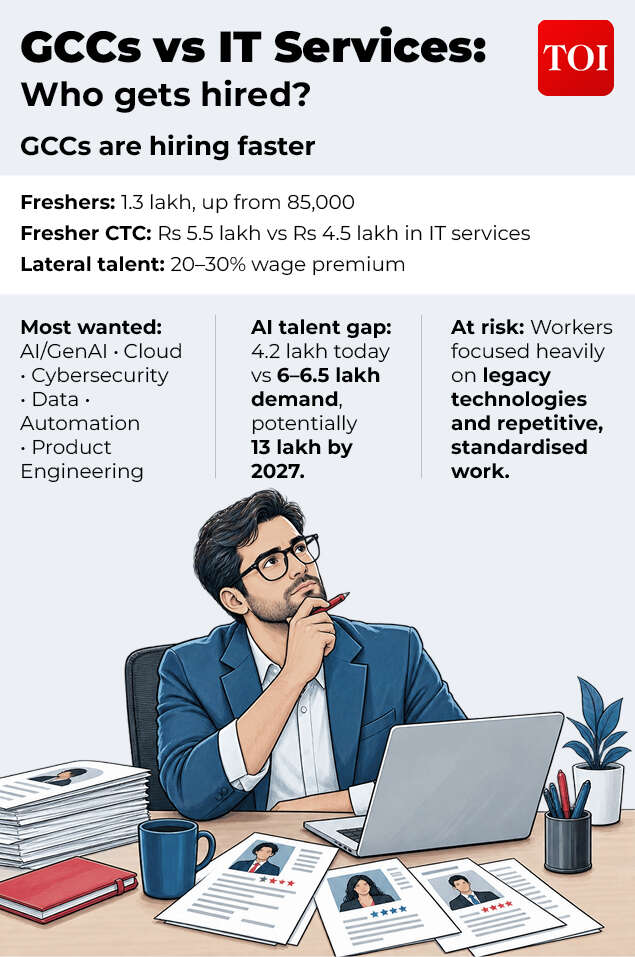
“India has around 4.2 lakh AI professionals today, against demand of 6-6.5 lakh, and demand could reach around 13 lakh by 2027,” she says.“The people who may struggle are those whose skills are heavily dependent on legacy technologies or repetitive, standardised work. The opportunity is moving towards people who can combine technology with AI, business understanding and problem-solving,” she notes.She expects GCCs to add around 4-6 lakh professionals over the next 2-3 years, based on the current pace of hiring.Neeti Sharma says fresher hiring is also picking up, with GCCs paying a premium, such as Rs 5.5 lakh CTC vs Rs 4.5 lakh CTC for freshers and a wage premium of about 20-30% on lateral skills.But, as she points out, the bigger shift is in the quality of demand. GCCs are increasingly looking for specialised talent that can own products, build AI capabilities and work closely with global business teams.
What’s in demand at GCCs?
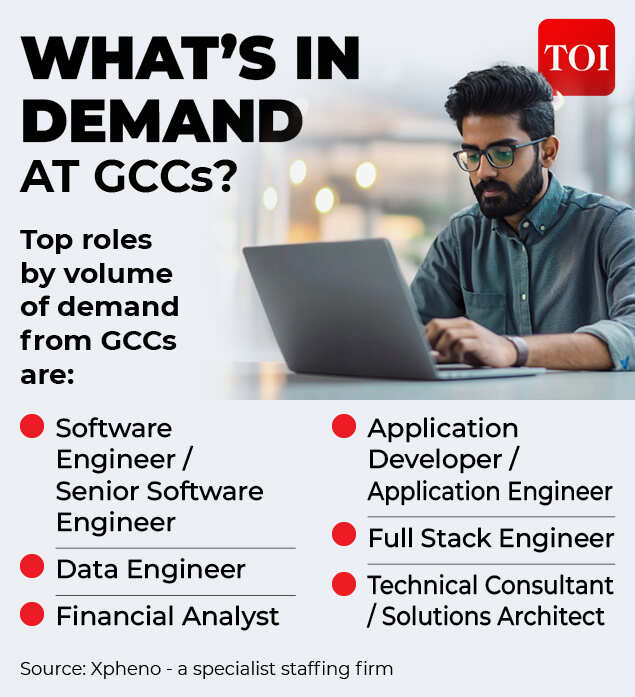
According to her, at the entry level, GCCs have hired around 1,30,000 candidates, up from 85,000 last year.The biggest opportunity is at the mid-career level, where GCCs need people who combine technology expertise with business understanding. At the senior level, demand is more specialised – architects, AI leaders, product leaders, cybersecurity and cloud specialists, she explains.Xpheno sees the strongest demand for talent from GCCs to be in the engineering and IT function, accounting for nearly 55% of current active openings.Finance & Account function follows with 12% and Operations & Program Management at 9%.These 3 enterprise functions continue to dominate hiring action, accounting for a collective 3/4th of the active demand from GCCs, Kamal Karanth says.“With the entry of mainstream AI enablement of operations, all enterprise functions and talent that don’t invest in visible AI upskilling and AI driven transformation will find themselves left behind in the race,” he cautions.Also Read | Fewer jobs, delayed onboarding: Why Indian IT sector is getting tougher for freshers
Can GCCs help meet the gap?
GCCs are increasingly drawing experienced talent away from traditional IT services firms. Lateral movement from IT services firms to GCCs currently stands at 23%.The Aon expert says that there is certainly absorption happening, particularly at the mid-career and senior levels where expertise, leadership, and domain knowledge are in high demand.However, it is not occurring at the scale or in the manner that many might assume.“In fact, I would argue that the decline of traditional IT services hiring is no longer automatically translating into increased hiring within GCCs,” she says.Historically, there was a relatively direct talent flow between the two sectors. Professionals leaving IT services often found opportunities in GCCs, and vice versa.“Today, that relationship has weakened considerably. The talent being released from one segment is not always aligned with the capabilities being sought by the other,” she says.Kamal Karanth of Xpheno points out that GCCs, irrespective of size and brand, are highly ROI sensitive on hiring spends, and expect the best value per dollar spent on talent acquisition.“The highest scale of talent action happens at the fresher & entry-levels and this is an expensive and low ROI layer for GCCs to undertake at scale,” he notes.While some GCCs are seen in the entry-level hiring scene, their scale is low to minimum and will collectively not offer a scale that IT services was known to offer.
Who gets hired?
The mid-layers offer promise on the scale front, as they are a critical layer for GCCs to build capabilities.“Senior IT professionals are in demand at GCCs, but specialisations become the filter. By nature these specialist layers are not high volume and will not add up as numbers that can qualify as large enough for sector level impact,” he says.By some estimates, GCC hiring demand rose to 12-14% in the March quarter from 4-6% in December, and GCCs now account for nearly 27% of India’s IT hiring demand, up from 15% in 2024.But, the nature of GCC hiring is changing, and companies are increasingly seeking specialised and experienced professionals.Reports suggest that workers with 4-10 years of experience are forming the core of demand. GCCs are continuing to build campus pipelines, with fresher hiring rising 12% in FY27 so far. This is in sharp contrast with IT services, where fresher hiring declined about 11% in FY26.Kamal Karanth of Xpheno believes that the high concentration of US headquartered GCCs is a factor that deeply impacts growth prospects of the Indian GCCs cohort.“Any projection on GCC hiring should factor in the current events in the US and the pace at which other geographies are catching up on the GCC count and composition,” he tells TOI.Given the current context, he believes that Indian GCCs can potentially absorb 150,000 to 200,000 each year over the next 2-3 years.“Crossing the 200,000 mark per year would require better geo-political and geo-economic conditions, to increase greenfield GCC landings and significant expansions of existing units,” he says.
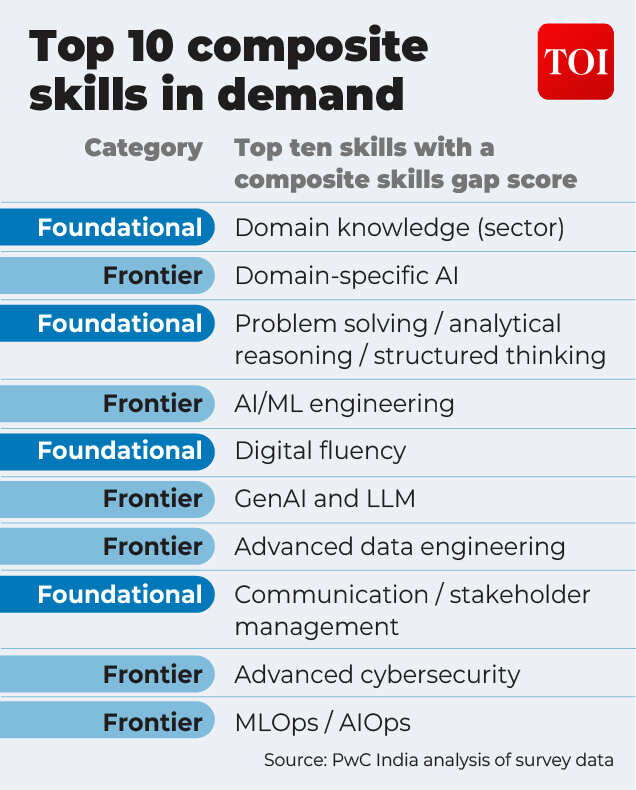
Top 10 composite skills in demand
The bottom line
Experts say that the demand exists, the supply is a constraint because niche skills are required and a skill gap exists.As per the PwC report, the single biggest constraint facing GCCs today is the absence of professionals who combine deep domain expertise with advanced technology capabilities.This is followed by intense competition from other GCCs, IT services firms, and startups chasing the same scarce talent pool, and a critical deficit of senior leadership talent with AI-era strategic competencies.“This supply-side challenge is multi-layered and self-perpetuating. Acquiring AI-ready talent is becoming increasingly difficult, driven by scarce specialised capabilities, leadership gaps, and intense market competition,” the PwC report says.“The hybrid, senior, AI-fluent talent with domain expertise that India’s GCC ecosystem needs most is hardest to find, most expensive to acquire, and most fiercely competed for across the market,” it adds.Also what needs to be understood is that the Indian IT services cohort continues to have a dominant position, despite the relative slowdown in the last few years.According to Xpheno, the IT Services cohort has, over the last 5 fiscals, added a net of over 970,000 headcounts while the GCCs cohort has added over 650,000.Gross hiring action, i.e net additions plus attrition linked replacement hiring, in the IT services cohort adds up to nearly 2 million during this period. Meanwhile the gross hiring by the GCCs cohort is a little over 1.3 million.“The sheer scale of talent action by volume remains highest in the IT services cohort compared to the GCCs cohort,” says Kamal Karanth.The IT services cohort continues to dominate the tech sector accounting for over 34% of total headcount of the sector.“While GCCs have emerged as the dark horses over the last 3 fiscals, the IT services cohort has been the sleeping giant of India’s tech sector,” Karanth says.